ZoomInfo vs. Clay

ZoomInfo vs. Clay: what’s the difference?

Clay is a spreadsheet-style canvas that sequences 150+ external data providers in a waterfall, with no proprietary database of its own. ZoomInfo is an all-in-one AI GTM platform: a verified data foundation, the GTM Context Graph reasoning layer on top of it, delivered with universal access through ZoomInfo's own UI, headless through GTM.AI, or in your native tech stack.

By submitting this form, you agree to ZoomInfo's Privacy Policy and Terms of Use.
You may unsubscribe at any time.

adobe
Microsoft logo1
Google logo1
airbnb logo.svg
Seismic Logo
Canva logo1
Snowflake
Figma logo.svg
adobe
Microsoft logo1
Google logo1
airbnb logo.svg
Seismic Logo
Canva logo1
Snowflake
Figma logo.svg
adobe
Microsoft logo1
Google logo1
airbnb logo.svg
Seismic Logo
Canva logo1
Snowflake
Figma logo.svg

Why do GTM teams choose ZoomInfo over Clay?

Clay's flexibility means technical GTM operators have good reasons to like it. But that flexibility comes from having no data foundation of its own, which means the customer inherits the work of verifying, reconciling, and maintaining whatever the waterfall returns. ZoomInfo starts from a different premise: own and verify the data first, reason over it with the GTM Context Graph, then make orchestration and execution native to the platform, most visibly through GTM Studio, so teams aren't left assembling and babysitting a multi-vendor stack.

1-1

A verified foundation, not an assembled one

500M contacts and 100M companies, verified continuously by 300+ human researchers and machine learning that processes 1.5B+ data points daily, reaching up to 95% first-party accuracy. Clay has no proprietary database. It aggregates whichever provider in its waterfall answers first, so quality, freshness, and reconciliation become the customer's job.

2-1

GTM Studio: orchestration and execution in one platform

GTM Studio turns a plain-language play description into a live workflow running on ZoomInfo's verified data, a parallel waterfall across 25+ sources, and the GTM Context Graph, then executes it natively (CRM sync, routing, ad audiences, sequence triggers). Clay's canvas prepares and routes data, but execution still happens in separate connected tools that a GTM engineer must build and maintain.

3-1

One contract, not a multi-vendor stack

Free to start with consumption credits based on usage, covering data, orchestration, intent signals, and execution under a single agreement. Clay's public per-tier pricing is genuinely transparent, but it's the starting point, not the full cost: underlying provider subscriptions, connected execution tools, and the RevOps engineering time to build and maintain workflows all sit on top of it.

ZoomInfo vs. Clay: features comparison

Compare ZoomInfo directly to Clay at a high level across core GTM capabilities.

Features
ZI-logodesktop-2-clay-logo

Platform type

An all-in-one AI GTM Platform: a proprietary verified data foundation, the GTM Context Graph reasoning layer, with universal access.

A spreadsheet-style orchestration canvas that sequences 150+ external data providers in a waterfall. Clay maintains no proprietary database, so data quality depends entirely on whichever provider returns a match

Core purpose

Own and verify a data foundation first, reason over it with the GTM Context Graph, then make orchestration and execution native through GTM Studio

Aggregate data from external providers through sequential waterfall enrichment, then hand execution off to whichever connected tool a team wires up separately

Data foundation

500M contacts, 100M companies, 135M+ verified phone numbers (120M direct dials), and 200M+ verified business emails, built and verified by 300+ human researchers processing 1.5B+ data points daily

No proprietary database. Aggregates 150+ external providers in a sequential waterfall that queries them in priority order and stops at the first match

Data quality

Continuously verified foundation reaching up to 95% first-party accuracy

Quality depends entirely on whichever provider returns first. No verification layer of its own, so reconciliation, deduplication, and QA fall to the customer

GTM orchestration

GTM Studio turns a plain-language play description into a live workflow running on verified data plus a parallel waterfall across 25+ sources, then executes natively (CRM sync, routing, ad audiences, sequence triggers)

A spreadsheet-style canvas (plus the Sculptor natural-language layer) that sequences providers one at a time and stops at the first match; execution still happens in separate connected tools a GTM engineer wires up

AI Capabilities

The GTM Context Graph reasons across CRM history, Chorus conversation intelligence, and behavioral signals to surface which accounts are in an active buying cycle

Claygent browses the web to extract structured data points a conventional database doesn't carry, useful for niche research, but with no proprietary predictive scoring or conversation intelligence of its own

No-code operations

GTM Studio is a codeless play builder purpose-built for RevOps and GTM engineering teams. No scripting required

Requires dedicated GTM engineering capacity to build and maintain workflows. Clay's own cohort training and certification programs reflect how much operational ownership the platform expects from its users

Workflow automation

Parallel waterfall enrichment across 25+ sources runs at no additional cost inside GTM Studio, with native execution: CRM sync, account routing, ad audience activation, and sequence triggers all in one platform

Sequential, single-match waterfall via the canvas. Sequences, calls, and ad campaigns still run in whichever connected tool a team wires up separately

Pricing model

Flexible packages and the option to start using for free via and on consumption-based pricing at GTM.AI

Dual-currency model (actions and data credits): Free (6,000 actions/year), Growth ($446/month billed annually, from 480,000 actions/year), and custom Enterprise.

SOC 2 Type II, ISO 27001, GDPR, and CCPA, documented as part of an enterprise-grade security stack

Compliance posture is not prominently documented in Clay's public materials

Clay vs. ZoomInfo: Data quality & coverage

ZoomInfo starts from a verified data foundation and builds orchestration on top of it; Clay does things the other way around. Let's see how the data compares as a result.

ZoomInfo's data

ZoomInfo maintains its own dataset: 500M contacts, 100M companies. ZoomInfo also runs parallel waterfall enrichment across 25+ additional sources inside GTM Studio for supplemental coverage, but the primary foundation is proprietary and verified, not assembled from external providers on each lookup.

Snowflake built its account propensity model on ZoomInfo's firmographic and technographic data and saw 2x higher conversion rates and 90% higher opportunity open rates on ZoomInfo-scored accounts.

Clay's data

Clay is an orchestration layer. It doesn't own a contact database. Instead, it aggregates data from external providers, running a sequential waterfall that queries them in priority order and stops at the first match.

That structure can surface coverage from sources a single vendor might not reach, but the quality of each data point is only as good as the provider that returned it. Clay has no verification layer of its own; reconciliation, deduplication, and QA are the customer's responsibility.

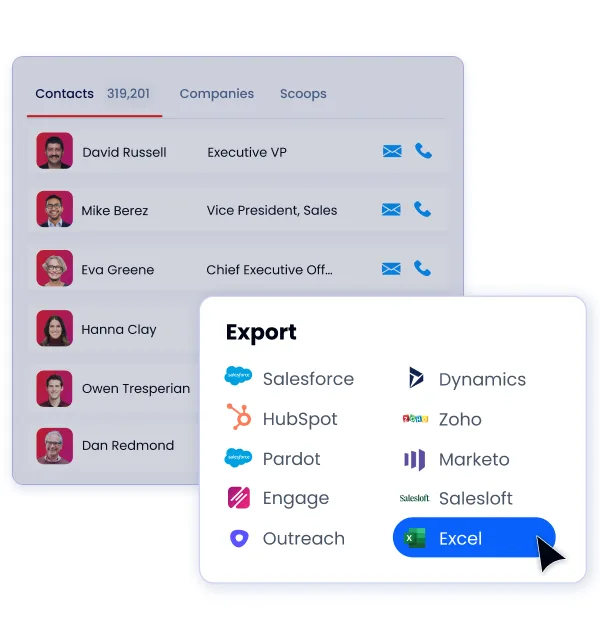
Mobile map global presence

GTM Studio vs. Clay: Workflow orchestration

GTM Studio and Clay's canvas both promise to orchestrate your GTM workflows, but they start from very different premises.

ZoomInfo's GTM Studio

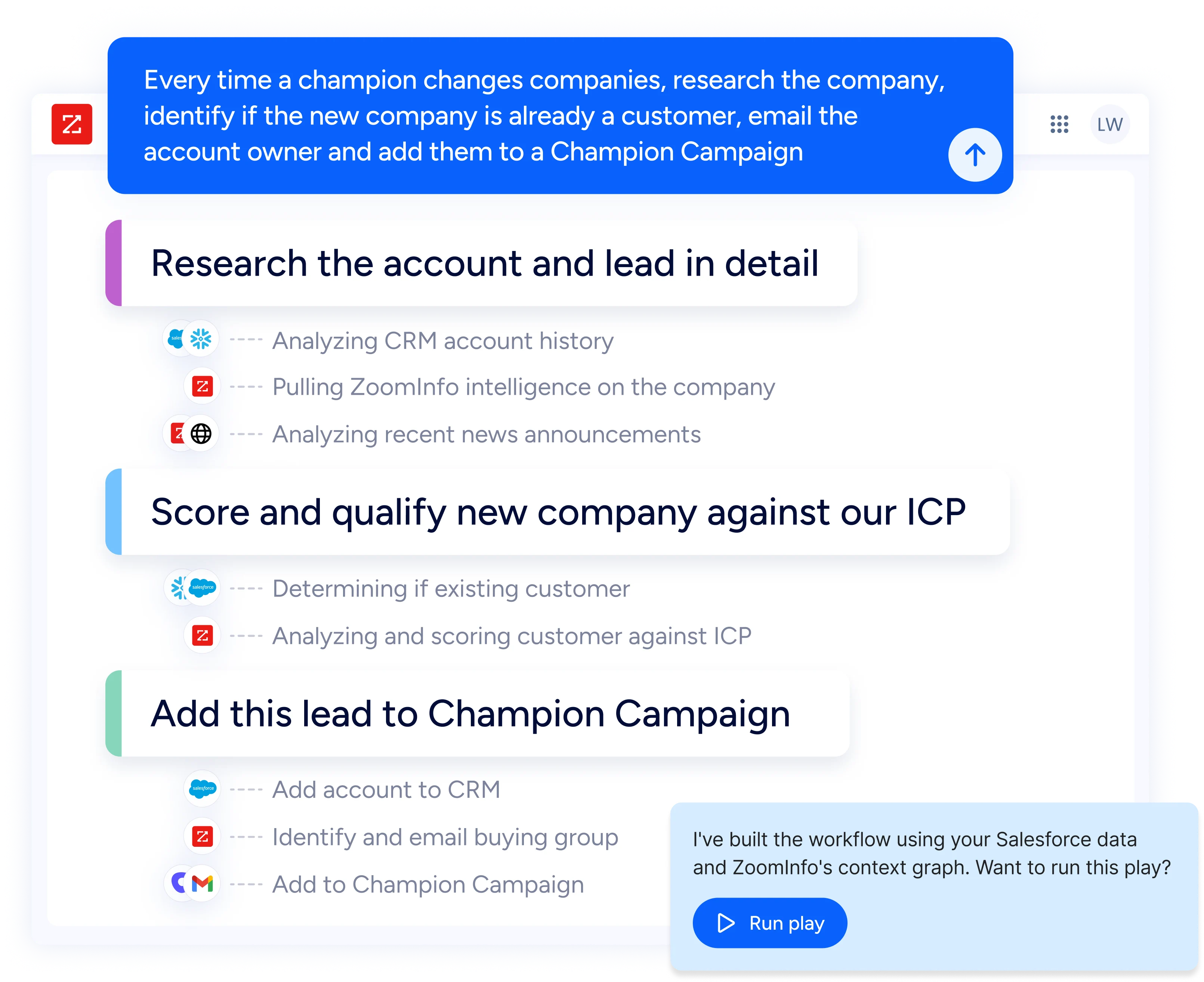
GTM Studio is ZoomInfo's codeless play builder for RevOps and GTM engineering teams. Workflows are described in natural language ("enrich all new CRM accounts, score for intent, route high-fit accounts to SDR sequences") rather than assembled in spreadsheet logic. GTM Studio builds and runs that play directly on ZoomInfo's verified data, with parallel waterfall enrichment across 25+ sources that returns the highest-confidence match rather than just the first one found, and on signals from the GTM Context Graph, which processes 1.5B+ data points daily by fusing ZoomInfo's B2B data with CRM records, Chorus conversation intelligence, and behavioral signals.

Native execution closes the loop without tool-hopping: CRM enrichment, account routing, ad audience activation, and sequence triggers all run inside the same platform, under one contract that also ships with the ZoomInfo MCP server for AI-agent integration.

Clay's canvas

Clay's workflow surface is a spreadsheet-style canvas: GTM engineers build tables, define column logic, sequence provider calls one vendor at a time, transform data with Claygent, and trigger downstream actions through integrations with tools like Outreach, Salesloft, HubSpot, and Salesforce. Sculptor adds a natural-language layer for describing workflow logic in plain text, but the underlying model is still sequential (Clay stops at the first match rather than scoring across all sources), and the canvas prepares and routes data rather than executing on it. Sequences, calls, and ad campaigns still run in whichever connected tool a team wires up separately.

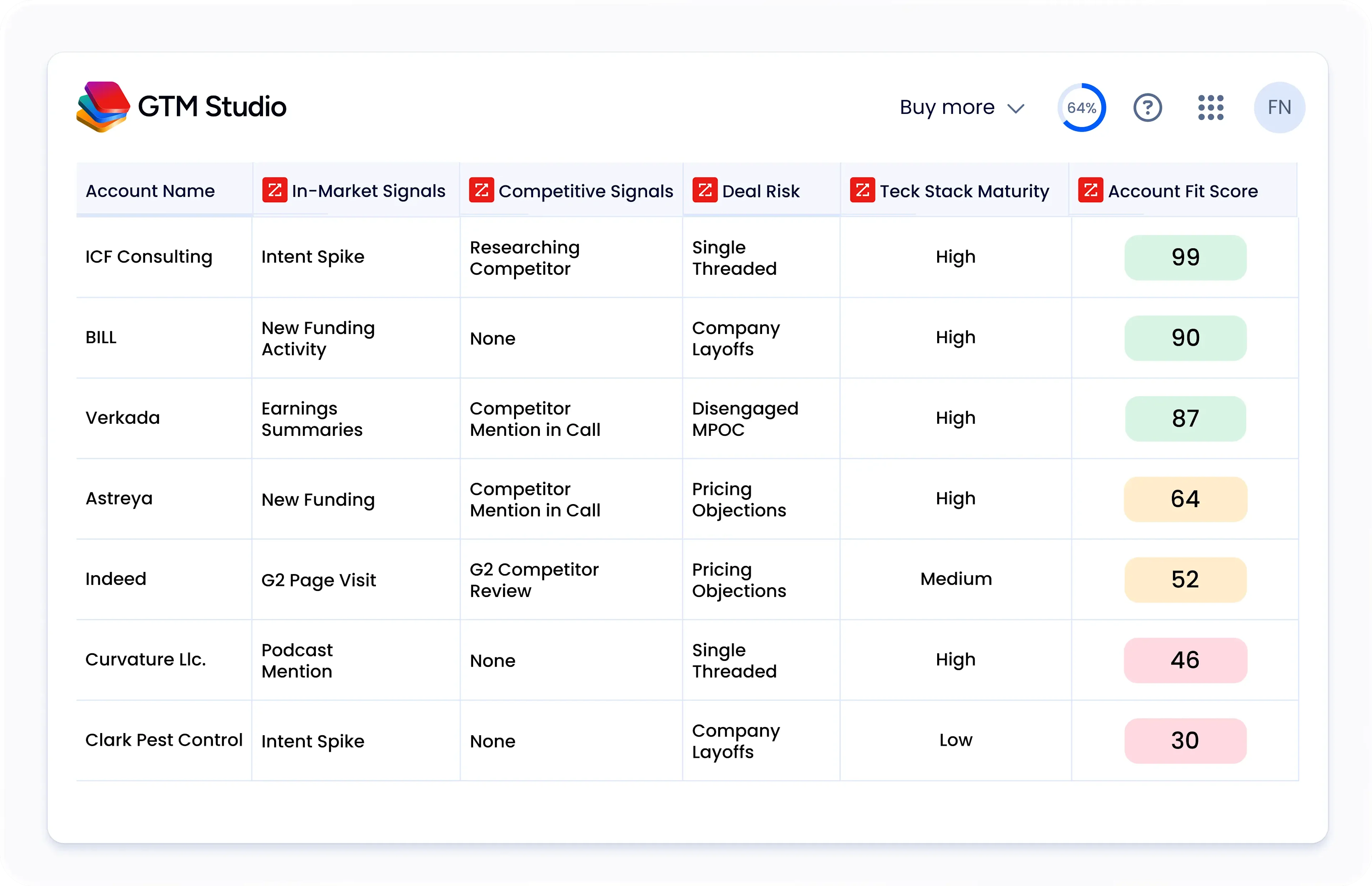
GTM Studio account signals table

ZoomInfo vs. Clay: AI capabilities & buying signals

AI is only as good as the signal it reasons over, and that's where ZoomInfo and Clay diverge most.

ZoomInfo's AI and intent data

ZoomInfo's intent data is native, built on 210M+ IP-to-Organization pairings, and feeds directly into the GTM Context Graph, the intelligence layer that fuses B2B data with a customer's own CRM activity records, Chorus conversation intelligence, and behavioral buying signals. The result is a system that reasons across signals a team has already accumulated to identify which accounts are showing the highest purchase intent right now, which contacts have gone cold despite previous engagement, and which accounts fit an ICP that historically closes fastest, rather than simply matching a firmographic filter.

Clay's AI and intent data

Clay's AI agent, Claygent, is designed to browse the web and extract structured data points that a conventional database doesn't carry, which is genuinely useful for niche qualification and custom research tasks. Clay's intent signals (job changes, hiring activity, news events, and web intent on the Growth tier) come from providers in its waterfall and can trigger plays effectively for straightforward, event-based outreach.

What Clay does not provide is proprietary predictive intent scoring or conversational intelligence. It can tell a team that something changed at an account; it does not reason across CRM history, conversation data, and behavioral signals the way the GTM Context Graph does to explain whether that account is actually in an active buying cycle.

GTM Studio intent and fit signals

ZoomInfo vs. Clay: Integrations, APIs, MCP & compliance

Both platforms now expose their data to AI agents. What differs is what's underneath.

ZoomInfo's access model and compliance

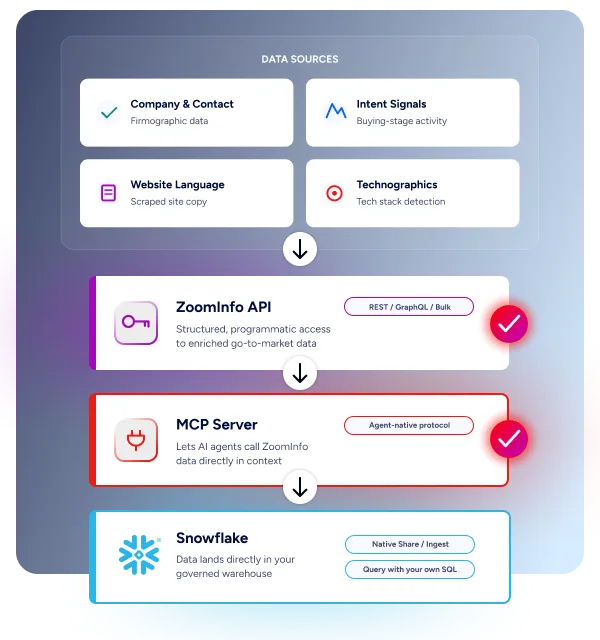
ZoomInfo supports the same verified data and intelligence surface through GTM Workspace for sellers, GTM Studio for marketers and RevOps, or directly through APIs and the ZoomInfo MCP server for developers and AI agents. Both platforms now offer MCP servers, but the difference is what intelligence each one exposes: ZoomInfo's MCP delivers verified contact and company data, GTM Context Graph signals, and intent data to any AI agent, drawing on a proprietary, continuously verified foundation.

ZoomInfo's compliance posture includes SOC 2 Type II, ISO 27001, GDPR, and CCPA, documented as part of its enterprise-grade security stack.

Clay's access model and compliance

Clay is designed to sit on top of many external tools and providers, so integrations are central to its value, and its MCP server is available at clay.com/mcp, surfacing Clay's own workflow data. That flexibility means the customer typically owns more of the integration logic and maintenance burden, since every connected provider and downstream tool is a separate relationship to manage.

Clay's compliance posture is not prominently documented in its public materials, in contrast to the certifications ZoomInfo publishes.

enterprise-integrations

Clay vs. ZoomInfo: pricing

The tier price is rarely the full picture on either side, but the two pricing models start from opposite premises.

ZoomInfo's pricing

Free to start with consumption credits based on usage. Waterfall enrichment inside GTM Studio comes at no additional cost for ZoomInfo customers with access to it, and the same contract covers data, orchestration, intent signals, and execution, with no separate line items for provider costs. The practical evaluation question isn't which list price is lower; it's what operating model a team is buying, and what it costs to run at the accuracy and scale that team actually needs.

Clay's pricing

Clay uses a dual-currency model based on Actions (platform orchestration: running enrichments, calling AI models, exporting data) and Data Credits (the underlying data itself, purchased from Clay's marketplace providers). Tiers run from Free (6,000 actions/year, 1,200 data credits/year) to Growth ($446/month billed annually, from 480,000 actions/year) to custom Enterprise pricing, with a public pricing calculator that lets teams model costs before talking to sales, a genuine advantage for budget exercises.

The tier price is the starting point, not the full picture. Total cost of ownership also includes the underlying provider subscriptions or data credit costs for each source in a waterfall, the cost of whichever execution tools a workflow routes into, and the RevOps engineering time required to build and maintain that workflow as provider APIs and schemas change. Teams evaluating Clay against ZoomInfo's single-contract model should price all three, not just Clay's published tier.

NEW-PRICING

Why teams are switching to ZoomInfo?

Teams switch to ZoomInfo when they need more than enrichment. With stronger data, better workflows, and real results, it’s the clear choice for revenue teams ready to scale.

Zoominfo is the GOAT contacts and email platform... the ability to get the right info I need to hunt

Mike Garcia

Sales Professional, Array Corporation (switched from Apollo.io)

I've used ZoomInfo at my previous 4-5 companies and as a result, I've become a champion of the tool. I was brought on at my current company to build an outbound motion and have replaced Apollo with ZoomInfo to successfully do that... better data quality and more robust tool

Jeff Kirchick

Sales Professional, allwhere (switched from Apollo.io)

I have tested Dun & Bradstreet, Apollo.IO, and Lusha. Zoominfo has way more richer tools, in my opinion, more accurate data, and more contacts

Oles Skakalskiy

Sales Professional, AssuredPartners

At Elite Printing and Packaging, we have used other software but have had the best experience with ZoomInfo Sales & Engage... More Quality emails, Phone #'s just better quality of leads, closing more deals

Debi Dessieux

Sales Professional, Elite Printing and Packaging (switched from Apollo.io)

Join the #1 AI GTM platform powering 35,000+ companies

Award imageAward imageAward imageAward image

FAQs

What's the main difference between ZoomInfo and Clay?

Clay is an orchestration layer: a spreadsheet-style canvas that sequences 150+ external data providers in a waterfall, with no proprietary database of its own. ZoomInfo is an all-in-one AI GTM Platform built on a verified data foundation, the GTM Context Graph reasoning layer, and Universal Access through GTM Workspace, GTM Studio, or GTM.AI. The real question isn't which tool is more flexible in a demo, it's whether your team wants to own and maintain a multi-vendor workflow or run on a single, continuously verified foundation with orchestration and execution already built in.

Is Clay a true alternative to ZoomInfo?

Not as a full replacement for most teams. Clay's waterfall aggregates results from external providers, but it doesn't own or verify the underlying data, so replacing ZoomInfo with Clay means trading a verified-data foundation for an aggregation layer whose quality depends on whichever provider returns the first match. Some teams run both: ZoomInfo as the primary data and intelligence foundation, Clay as a supplemental orchestration layer for specialized enrichment tasks.

Which platform has better data quality and coverage?

ZoomInfo maintains its own dataset of 500M contacts, 100M companies, 135M+ verified phone numbers (120M direct dials), and 200M+ verified business emails, built and verified by 300+ human researchers with a system that processes 1.5B+ data points daily. Clay doesn't own a contact database; it aggregates data from external providers through a sequential waterfall that stops at the first match, so coverage can be broad but quality varies entirely by whichever provider answered, with no verification layer of its own.

Can ZoomInfo activate plays across my tech stack?

Yes. GTM Studio executes natively across the same platform where data and intelligence live: CRM enrichment, account routing, ad audience activation, and sequence triggers all run under one contract that also ships with the ZoomInfo MCP server for AI-agent integration. Clay's canvas prepares and routes data, but sequences, calls, and ad campaigns still run in whichever connected tool a team wires up separately, such as Outreach, Salesloft, HubSpot, or Salesforce.

ZoomInfo vs. Clay: Which platform is more compliant with global data privacy laws?

ZoomInfo's compliance posture includes SOC 2 Type II, ISO 27001, GDPR, and CCPA, documented as part of its enterprise-grade security stack. Clay's compliance posture is not prominently documented in its public materials, and because Clay sits on top of many external providers, a team typically has to vet each connected vendor's own compliance practices separately.

What automation and AI capabilities does ZoomInfo provide compared to Clay?

ZoomInfo's intent data is native, built on 210M+ IP-to-Organization pairings, and feeds directly into the GTM Context Graph, which fuses B2B data with a team's own CRM activity, Chorus conversation intelligence, and behavioral buying signals to identify which accounts are showing real purchase intent right now. Customers using ZoomInfo's AI capabilities report a 46% increase in win rates and an 83% increase in average deal size. Clay's AI agent, Claygent, browses the web to extract structured data points a conventional database doesn't carry, which is useful for niche research, but Clay has no proprietary predictive intent scoring or conversation intelligence of its own.

Why do teams outgrow Clay and switch to ZoomInfo?

Clay's tier pricing is transparent as a starting point, but the total cost of ownership also includes the underlying provider subscriptions or data credit costs for each source in the waterfall, the execution tools a workflow routes into, and the RevOps engineering time to build and maintain that workflow as provider APIs and schemas change. ZoomInfo is free to start with consumption credits based on usage, and one contract covers data, orchestration, intent signals, and execution, with no separate line items for provider costs, which is why teams spending meaningful time managing provider integrations often consolidate onto ZoomInfo.

What types of organizations are best suited for Clay?

Clay is the stronger fit for GTM engineers who want maximum control to compose custom workflows across a large marketplace of external data providers, and for teams with dedicated engineering capacity and highly specific enrichment logic. Teams that want a single vendor with enterprise data quality, native intent signals, and direct execution typically lean toward ZoomInfo instead.