Why do teams choose ZoomInfo over Lusha?
Lusha's ease of use and transparent pricing are real strengths for a rep who just needs a phone number today. But teams that scale past rep-level prospecting consistently run into the same wall: Lusha's data is a snapshot rather than a continuously verified asset, its signals surface in a dashboard rather than triggering workflow, and its conversation intelligence and CRM sync are early-stage rather than built for coordinated, multi-team execution. ZoomInfo is built to remove that ceiling.
Verified data at a different scale
500M contacts and 100M companies, with 135M+ verified phone numbers (120M direct dials) and 200M+ verified business emails, continuously refreshed by an automated pipeline and 300+ human researchers. Lusha reports 280M+ contacts and 152M+ email addresses as database counts; G2 reviewers cite inaccurate or outdated emails and phone numbers as Lusha's top complaint, and coverage gaps outside North America.
Signals that trigger workflow, not just a dashboard
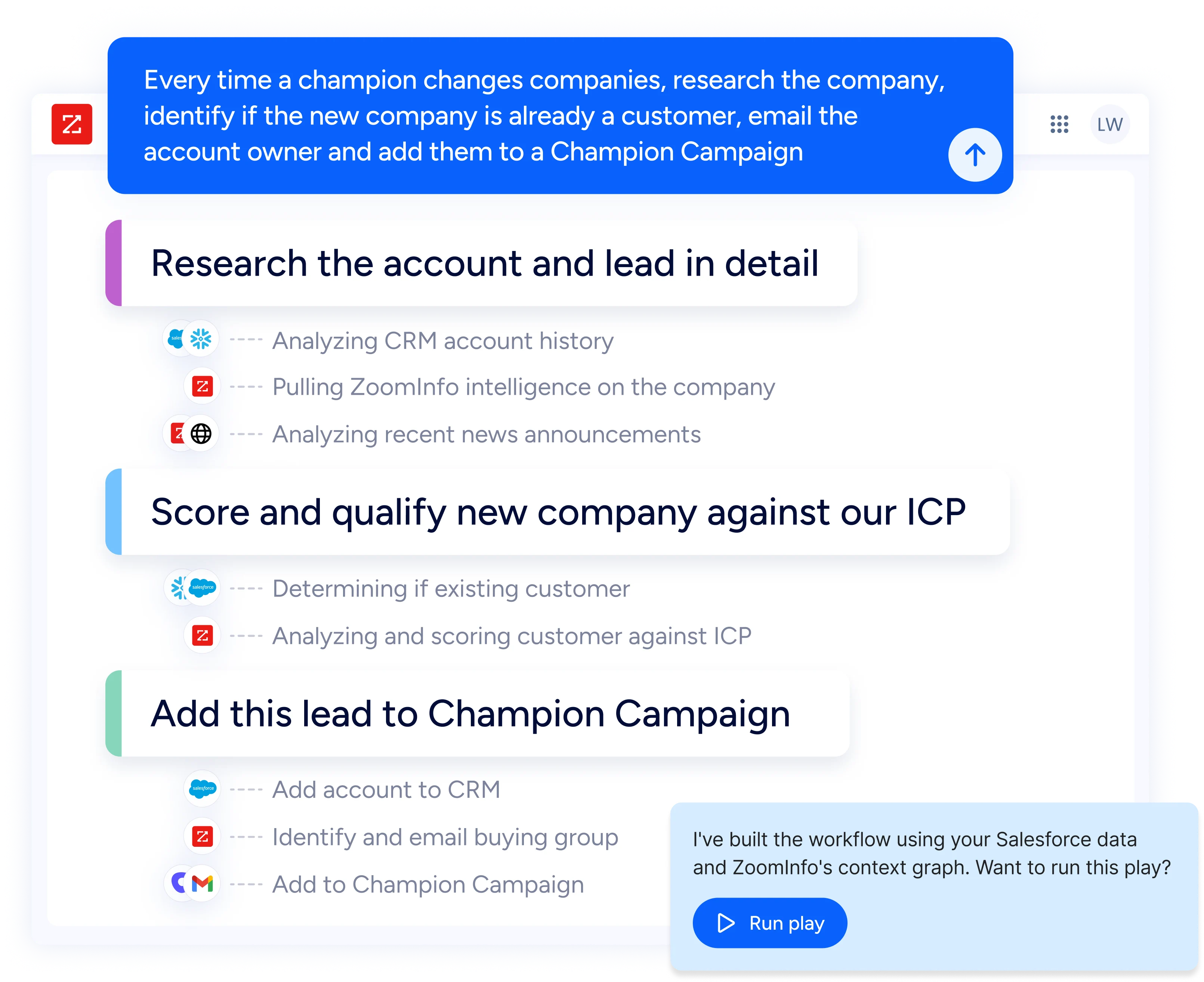
ZoomInfo connects proprietary intent data, Guided Intent, and website visitor identification directly to account prioritization, CRM routing, and automated next steps, so a signal can update a Salesforce field and queue a sequence step at the same time. Lusha's Bombora-based intent and buying signals (job changes, funding events, hiring activity) tell a rep when to reach out, but don't natively connect to downstream execution.
A GTM operating system, not a rep-level tool
The GTM Context Graph reasons across contact data, intent signals, Chorus conversation insights, and CRM context to recommend who to target, when to engage, and what to prioritize, coordinating sales, marketing, and RevOps. Lusha's AI (recommendations, playlists, email assistance) is genuinely useful for one seller building one list faster, but it operates at the individual level, not the system level.
ZoomInfo vs. Lusha: feature comparison
Compare ZoomInfo directly to Lusha at a high level across core GTM capabilities.
Feature | ||
|---|---|---|
Database size & attributes | 500M contacts, 100M companies, 135M+ verified phone numbers (120M direct dials), and 200M+ verified business emails | 280M+ contacts, 30M+ companies, 280M+ phone numbers, and 152M+ email addresses reported as raw database counts |
Verified by an automated pipeline, a contributor network, partner data, and 300+ human researchers who continuously verify and update the database | G2 reviewers consistently cite inaccurate or outdated emails and phone numbers as Lusha's top complaint, with coverage gaps outside North America and the UK | |
Proprietary intent data plus Guided Intent, exclusive to ZoomInfo, identifying topics historically correlated with deal success, plus WebSights website visitor identification | Bombora-based third-party intent data layered with buying signals such as job changes, funding events, and hiring activity. Signals surface in a dashboard but don't natively trigger downstream workflow | |
The GTM Context Graph reasons across contact data, intent signals, conversation insights, and CRM context to recommend who to target, when to engage, and what to prioritize | AI recommendations, prospect playlists, and email-writing assistance designed to help an individual rep build a list and start outreach faster | |
Chorus: a mature product with call capture, transcription, objection detection, deal-risk signals, and coaching workflows, feeding insights back into pipeline forecasting and rep development | A newer, beta-stage conversation feature focused on call recording, summaries, and basic action items | |
Website visitor identification, connecting anonymous traffic to known accounts | Not available as a native feature | |
CRM integrations quality | Broader, more enterprise-oriented integrations with bidirectional sync in major CRM workflows | Supports Salesforce and HubSpot natively, though much of its workflow pattern centers on exporting data outward rather than bidirectional sync |
Pricing | Flexible packages and the option to start using for free via and on consumption-based pricing at GTM.AI | Pricing starts from $37.45/month |
ZoomInfo meets the highest compliance standards (SOC 2, ISO 27001, GDPR) with a dedicated Trust Center and automated privacy processes | Lusha meets core global standards (SOC 2, ISO 27001, GDPR, CCPA) with solid privacy controls | |
Platform approach | An all-in-one AI GTM Platform: a 500M-contact verified data foundation, the GTM Context Graph intelligence layer (1.5B+ data points processed daily), and universal access through the UI, GTM.AI for developers and builders, or tools in your tech stack | A contact-discovery tool built around three surfaces (Workspace, a Chrome Extension, and an API) designed for individual sellers who need to find people and start outreach quickly |
Customer ROI & outcomes | Zoom increased revenue 300% and expanded its ZoomInfo license 5,900% since adoption; Spekit saw high-scoring accounts move through qualification 58% faster after expanding its ZoomInfo partnership | Limited public outcome data beyond efficiency gains from faster contact lookup |
Lusha vs. ZoomInfo: Data quality & coverage
Lusha and ZoomInfo take different approaches to data depth and verification.
ZoomInfo's data
ZoomInfo operates at a larger scale: 500M contacts, 100M companies. Verification combines automated collection, a contributor network, partner data, and more than 300 human researchers who continuously verify and update the database.
Lusha's data
Lusha reports 280M+ contacts, 30M+ companies, 280M+ phone numbers, and 152M+ email addresses. That is a legitimate data asset for the SMB and mid-market prospecting use cases where Lusha is strongest, and its Chrome extension overlays that data cleanly on LinkedIn and Sales Navigator pages. G2 reviewers, however, consistently flag inaccurate or outdated emails and phone numbers as Lusha's top complaint, and note that coverage drops significantly outside North America and the UK, with higher bounce rates reported in EMEA, APAC, and Latin America.

ZoomInfo AI & automation capabilities vs. Lusha
AI is where ZoomInfo and Lusha diverge most in ambition.
ZoomInfo's AI and automation
ZoomInfo's AI operates at the system level. GTM Workspace and GTM Studio are powered by the GTM Context Graph, which reasons across contact data, intent signals, conversation insights, and CRM context to recommend who to target, when to engage, and what to prioritize.
Spekit expanded its ZoomInfo partnership and saw high-scoring accounts move through qualification 58% faster, with AI-generated post-meeting summaries reducing administrative load.
Lusha's AI and automation
Lusha's AI is designed to help individual reps prospect faster: recommendations, playlists, and email assistance that reduce list-building time. For a rep who needs to build a list and get outreach moving, those features are genuinely useful, but they are rep-level productivity tools layered onto a database, not a system-level intelligence layer.


Intent Data: Real-time advantage with ZoomInfo
Both platforms surface buying signals. The difference is what happens after a signal fires.
ZoomInfo's intent data
ZoomInfo goes deeper on intent with proprietary intent data, including Guided Intent, which is exclusive to ZoomInfo and identifies topics historically correlated with deal success for a team's specific customer profile, rather than requiring manual topic selection. The practical difference is activation depth: a signal in ZoomInfo can trigger a workflow, update a CRM field, and queue a sequence step simultaneously, closing the gap between signal collection and signal activation.
Lusha's intent data
Lusha provides Bombora-based intent data layered with additional buying signals: job changes, funding events, hiring activity, and technology adoption shifts. These are useful, legitimate signals for timing outreach, but they surface as information for a rep to act on manually rather than triggering downstream workflow.

Lusha vs. ZoomInfo: Integrations
Getting a signal into a rep's hands is only half the job. The other half is what the surrounding tech stack does with it.
ZoomInfo's integrations support outreach
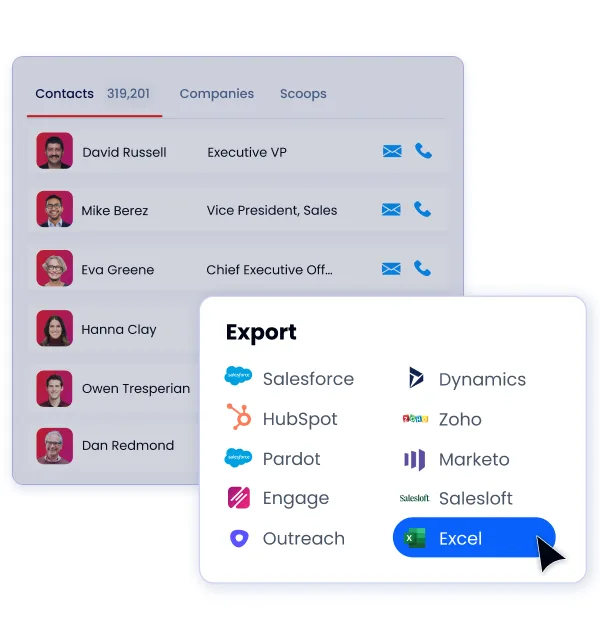
On outreach, ZoomInfo supports broader multi-channel execution through its Salesloft solution and partnership, bringing buying signals directly into seller engagement workflows. Integrations are broader and more enterprise-oriented, with bidirectional sync in major CRM workflows rather than one-way export.
Lusha's integrations
Lusha includes native email sequencing for a built-in, lightweight outreach workflow, but stays email-first with no native dialer or multi-channel orchestration. It supports Salesforce and HubSpot natively, though much of its workflow pattern centers on exporting data outward rather than maintaining bidirectional sync.

Lusha vs. ZoomInfo: API Access, MCP & Pricing
Both platforms have MCP servers for AI agents; let's dig deeper into them.
ZoomInfo's intelligence layer for AI agents
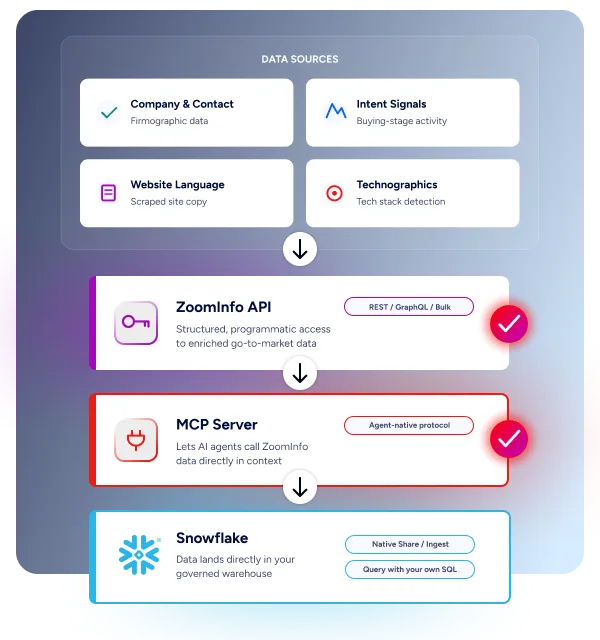
ZoomInfo's API spans data search, enrichment, intent signals, marketing activation, and platform-level use cases. Its MCP exposes a larger intelligence layer: verified contact data, GTM Context Graph signals, and GTM Workspace context, meaning an AI agent gets the surrounding intelligence that makes a contact actionable, not just the record itself. Teams that want to connect their own AI tools directly to that intelligence layer can do so through GTM.AI, ZoomInfo's agent-native context layer, via MCP, API or CLI.
Lusha's API & MCP
Lusha's API provides programmatic access for enrichment, prospecting, signals, and lookalike use cases, covering straightforward data workflows for teams building contact enrichment into internal tools. Lusha's MCP gives AI agents access to Lusha contact data in Claude, ChatGPT, and other LLM environments, delivering reliably on contact lookups specifically.

ZoomInfo’s compliance & privacy
ZoomInfo meets the highest enterprise standards with SOC 2 Type II and ISO 27001 certifications, a dedicated compliance team led by former regulators, and built in privacy by design features. Its global compliance framework, Trust Center, and robust security infrastructure make it ideal for large-scale, regulated organizations.

Why are teams switching to ZoomInfo?
Teams switch to ZoomInfo when they need more than enrichment. With stronger data, better workflows, and real results, it’s the clear choice for revenue teams ready to scale.
We can see everything in one place. We can see that the data is correct, understand the signals, and finally optimize our campaigns.
Shai Masot
Strategic Demand & Lead Generation
I’m really excited about the power of generative AI in general, and working with Copilot is a no-brainer because ZoomInfo is one of the key platforms in our tech stack.
Toby Carrington
Chief Business Officer
I give props to the data services team at ZoomInfo. They’ve done a really great job working with us to get us what we need.
David Gojo
Sales Data Science Manager
While our analysis initially suggested Cognism might have advantages for UK mobile data, we recognize ZoomInfo's broader capabilities and are willing to invest in the additional features like intent data. We've used ZoomInfo before and see the value in scaling our data volume with your platform
UK based Energy Company
Director of Sales
Join the #1 AI GTM platform powering 35,000+ companies


FAQs
What's the main difference between ZoomInfo and Lusha?
Lusha is built for rep-led contact discovery: a Chrome extension, a search workspace, and an API designed to help an individual seller find a person and start outreach fast, at a transparent, low entry price. ZoomInfo is an all-in-one AI GTM Platform: a 500-million-contact verified data foundation, an intelligence layer called the GTM Context Graph that processes more than 1.5 billion data points daily, and Universal Access through GTM Workspace, GTM Studio, and APIs and MCP. The question isn't which is more flexible for one rep, it's whether a team still needs only contact discovery or has outgrown that and needs data, signals, and execution to live in one system.
Is Lusha an alternative to ZoomInfo?
Lusha can be a reasonable option for smaller teams that primarily need contact discovery, simple prospecting, and a low-friction entry point. It is less suited to teams that need integrated intent signals, workflow automation, conversation intelligence, or multi-team orchestration, all of which sit at the center of what ZoomInfo is built to do.
Which platform has better data accuracy?
ZoomInfo operates at a larger scale: 500M contacts, 100M companies, 135M+ verified phone numbers, 120M direct dials, and 200M+ verified business emails, verified through automated collection, a contributor network, partner data, and more than 300 human researchers who continuously update the database. Lusha reports 280M+ contacts and 152M+ email addresses, but G2 reviewers consistently flag inaccurate or outdated emails and phone numbers as Lusha's top complaint, with coverage dropping significantly outside North America and the UK.
What advanced features does ZoomInfo offer that Lusha doesn't?
ZoomInfo combines a verified data foundation with system-level intelligence Lusha doesn't have. That includes Guided Intent, exclusive to ZoomInfo, which surfaces topics historically correlated with deal success without manual topic selection; WebSights website visitor identification; the GTM Context Graph, which reasons across contact data, intent signals, Chorus conversation insights, and CRM context; and Chorus itself, a mature conversation intelligence product with call capture, transcription, objection detection, and coaching workflows. Signals in ZoomInfo can trigger a workflow, update a CRM field, and queue a sequence step simultaneously, something Lusha's dashboard-based signals don't natively do.
Does ZoomInfo provide intent data?
Yes, and it goes deeper than Lusha's. ZoomInfo's proprietary intent data includes Guided Intent, exclusive to ZoomInfo, which identifies topics historically correlated with deal success rather than requiring manual topic selection, and WebSights adds website visitor identification that connects anonymous traffic to known accounts. Lusha relies more heavily on Bombora-based signals and buying signals like job changes and funding events, which are useful for prospecting timing but have a narrower activation depth since they don't natively trigger downstream workflow.
What automation capabilities does ZoomInfo offer?
ZoomInfo's AI operates at the system level: GTM Workspace and GTM Studio are powered by the GTM Context Graph, which reasons across contact data, intent signals, conversation insights, and CRM context to recommend who to target, when to engage, and what to prioritize. Spekit expanded its ZoomInfo partnership and saw high-scoring accounts move through qualification 58% faster, with AI-generated post-meeting summaries reducing administrative load, and SpringDB saw a 300% increase in database usability and a 30 to 50% uplift in average deal size using the full platform. Lusha's AI, by comparison, is built to help an individual rep prospect faster with recommendations, playlists, and email assistance layered onto its database.
Can ZoomInfo identify who visits my website?
Yes. WebSights adds website visitor identification, connecting anonymous web traffic to known accounts, and feeds directly into ZoomInfo's broader intent picture alongside Guided Intent. Lusha does not offer a comparable website visitor identification capability.
How does ZoomInfo ensure compliance with global privacy regulations?
ZoomInfo meets the highest compliance standards (SOC 2, ISO 27001, GDPR) with a dedicated Trust Center and automated privacy processes.
How does pricing compare between ZoomInfo and Lusha?
Lusha's pricing is fully public and genuinely transparent: Free (40 credits/month, 1 seat), Starter (from $37.45/month), Pro (from $52.45/month), Premium (from $299.95/month), and custom Scale pricing, a real strength for a smaller team sizing cost before committing. ZoomInfo is free to start, with consumption credits based on usage that scale with platform depth and team size, and ZoomInfo Lite offers a free entry point. The core tradeoff is that Lusha is easier to trial and buy as a lightweight prospecting tool, while ZoomInfo's investment is tied to a much broader set of capabilities, data, intent signals, automation, and conversation intelligence, and the ROI case strengthens once a team uses more than contact lookup alone.
Which platform offers better ROI for enterprise teams?
ZoomInfo's ROI case is strongest for teams using more than contact lookup alone. Zoom increased revenue 300% and expanded its ZoomInfo license 5,900% in its first year of broader adoption. Spekit saw high-scoring accounts move through qualification 58% faster after expanding its ZoomInfo partnership, and SpringDB saw a 300% increase in database usability and a 30 to 50% uplift in average deal size. Snowflake used ZoomInfo's firmographic and technographic data to build an Account Propensity Scoring model integrated directly into its data warehouse.
Can I switch from Lusha to ZoomInfo easily?
ZoomInfo makes switching easy with:
Data migration assistance
Dedicated migration support team
Training to help your team adapt