


Why do GTM teams choose ZoomInfo over 6sense?
6sense predicts which accounts are in-market from anonymous signals. ZoomInfo reaches the individual people at those accounts and surfaces why each deal is advancing or stuck.
Verified contact data, not just account signals
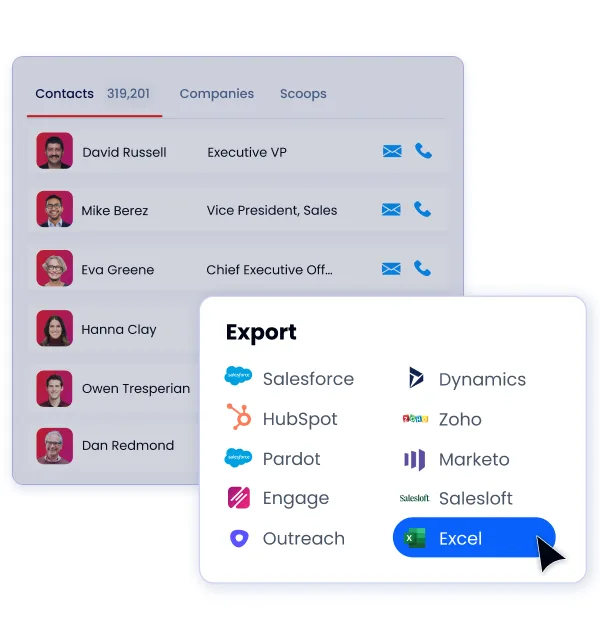
ZoomInfo delivers 500M contacts, 135M+ verified phone numbers, and 200M+ verified business emails with up to 95% first-party accuracy. 6sense's contact data (100M+ emails) is secondary to its intent engine, and G2 reviewers report that out of five contacts, two are good and the rest are obsolete.
Faster time to value
ZoomInfo implementations typically run under three weeks. 6sense implementations typically require 60+ days and dedicated administrators.
Transparent, contextual intelligence
ZoomInfo's GTM Context Graph shows exactly which buying signals led to an account recommendation. 6sense's intent scoring operates as a black box according to G2 reviewers, with sellers receiving account flags without the underlying reasoning.
ZoomInfo vs. 6sense: Features comparison
Compare ZoomInfo directly to 6sense from a high-level against core features.
Features | ||
|---|---|---|
Best for | Full-funnel GTM across sales, marketing, and ops | Marketing-led ABM and intent-driven GTM |
Core foundation | Comprehensive B2B data plus contextual intelligence | Intent signals and predictive AI |
Database scale | 415M+ profiles, 65M+ companies | |
Verified emails | 200M+ verified business emails | 100M+ emails |
Data accuracy | Up to 95% first-party accuracy | Not published |
Conversation intelligence | Chorus, native | Not available |
Implementation time | Under three weeks | 60+ days, dedicated admin required |
MCP / API access | API + MCP included in all relevant plans | API available; no MCP server |
Pricing model | Flexible packages and the option to start using for free via consumption-based pricing at GTM.AI; ZoomInfo Lite also available | Free Sales Intelligence tier (50 credits/month); paid tiers quote-based |
Which platform has better contact data: 6sense or ZoomInfo?
ZoomInfo leads significantly on verified contact quality.
ZoomInfo's contact data
The platform covers 500M contacts, 100M companies, 135M+ verified phone numbers, 120M direct-dial numbers, and 200M+ verified business email addresses. The verification pipeline combines automated ML scanning of 28M site domains daily, third-party partner data, a community of 200,000+ ZoomInfo Lite users, and 300+ human researchers. First-party data reaches up to 95% accuracy.
6sense's contact data
6sense's contact data (100M+ emails) is secondary to its intent and predictive capabilities. For sales teams, the practical difference shows up at the point of outreach: a direct dial that rings and a business email that lands are what separate productive prospecting from wasted sequences. G2 reviewers note that out of five contacts, two are good and the rest are obsolete.

6sense vs. ZoomInfo: how the two platforms compare on intent data
Both platforms track intent signals, but through different mechanisms and with different emphasis.
ZoomInfo's intent data
ZoomInfo Intent draws from 210M IP-to-organization pairings and 6 trillion+ new keyword-to-device pairings sourced monthly. Guided Intent, exclusive to ZoomInfo, identifies topics historically correlated with deal success for each customer's specific business, rather than requiring manual topic selection from a generic library. ZoomInfo treats intent as one signal layer among many, unified through the GTM Context Graph alongside CRM data and conversation intelligence from Chorus.
6sense's intent data
6sense's Signalverse ingests first-party, second-party, and third-party intent data from its proprietary B2B Network, first-party website activity, and native integrations with Bombora, G2, TrustRadius, TechTarget, and others, processing over one trillion signals daily. 6sense makes intent the organizing principle of the entire platform, classifying accounts into predictive buying stages and measuring momentum. Both ZoomInfo and 6sense were named Leaders in the Forrester Wave for Intent Data Providers, Q1 2025.

Intelligence layers: Signalverse vs. GTM Context Graph
Both platforms have built intelligence layers that go beyond raw data.
ZoomInfo's GTM Context Graph
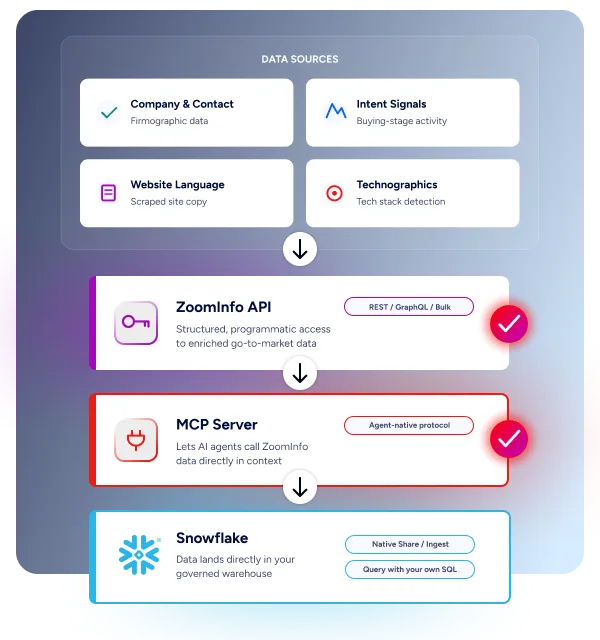
ZoomInfo's GTM Context Graph fuses ZoomInfo's B2B data with a customer's CRM records, conversation transcripts captured through Chorus, email threads, and behavioral signals, processing 1.5B+ data points daily. It captures the connections between signals and outcomes, identifying why deals move or stall, and the same reasoning layer is available through GTM Workspace, GTM Studio, and APIs and MCP.
6sense's Signalverse
6sense's Signalverse is a signal processing engine. It ingests intent data, applies predictive models trained on each customer's historical outcomes, and outputs buying stage classifications, account prioritization scores, and dynamic audience segments, answering which accounts are in-market and how far along are they. 6sense's approach is stronger for top-of-funnel account identification and marketing orchestration; ZoomInfo's approach is stronger for mid-funnel deal execution and account management.

Is 6sense or ZoomInfo better for ABM?
Both platforms are Gartner Magic Quadrant Leaders for Account-Based Marketing Platforms (2025). The right choice depends on whether your primary bottleneck is account identification or contact-level execution.
ZoomInfo for ABM
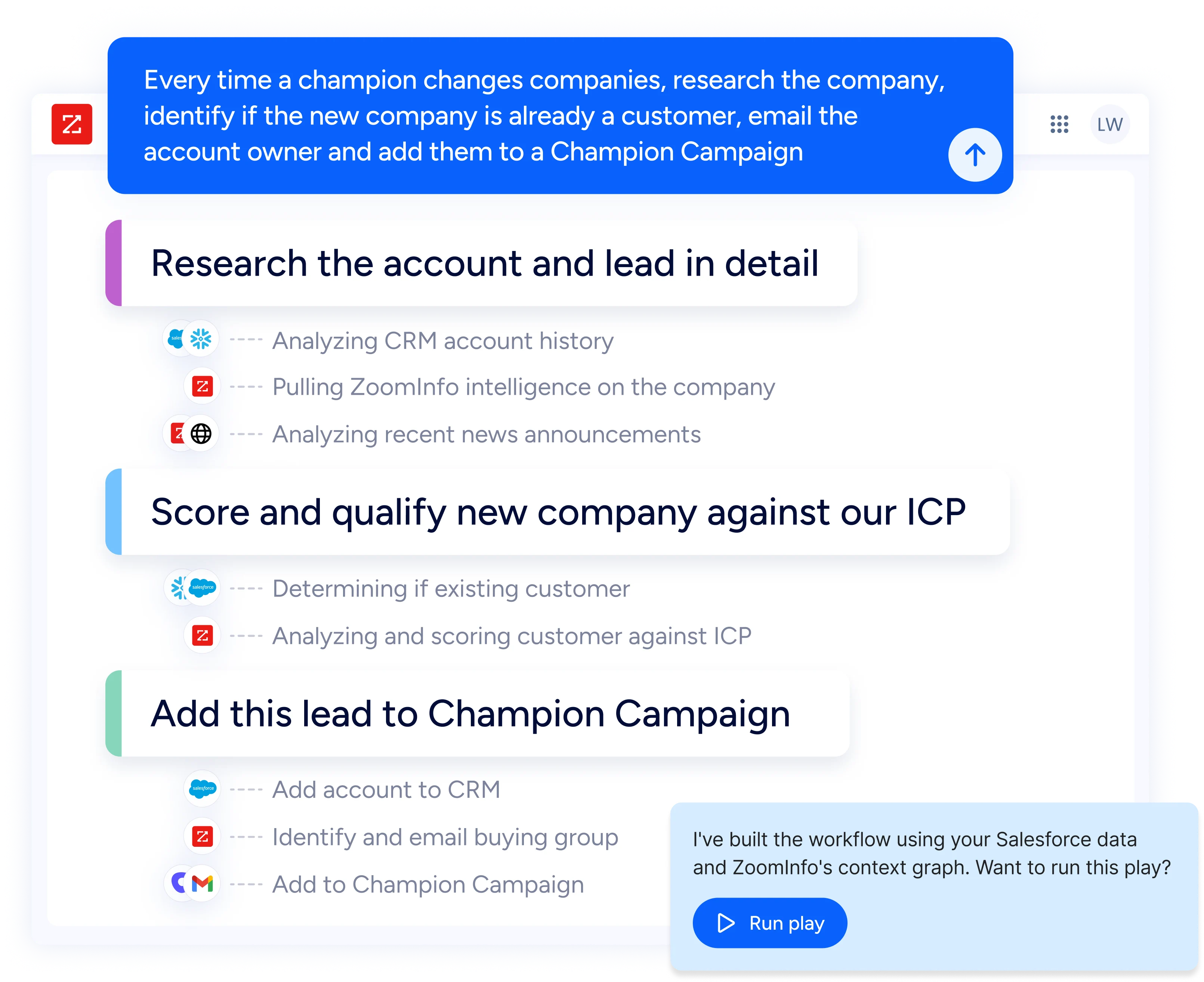
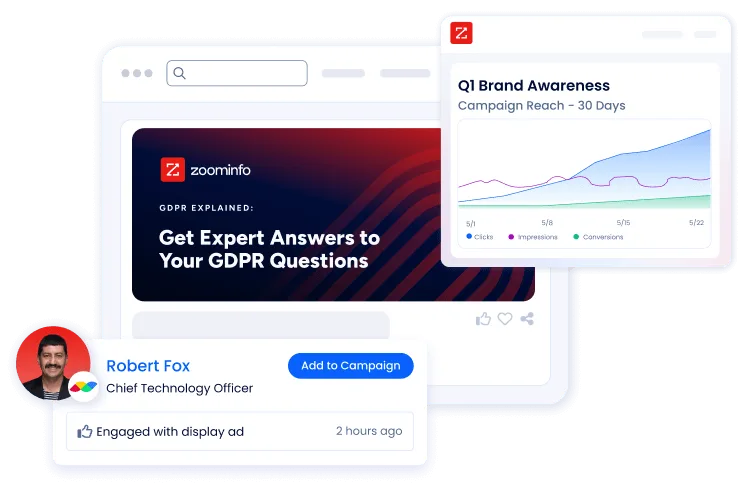
ZoomInfo is the stronger choice when ABM must connect to verified outreach at the contact level. ZoomInfo Marketing offers a native demand-side platform, FormComplete for form enrichment, and contact-level site visitor identification. GTM Studio lets marketers and RevOps describe target audiences in natural language and launch multi-channel plays without engineering support. Smartsheet reported a 40%+ increase in form fills, 84% increase in MQLs, and 59% increase in win rate using ZoomInfo's marketing tools.
6sense for ABM
6sense is the stronger anchor for marketing-led ABM programs where the primary challenge is identifying in-market accounts from anonymous signals. Its Signalverse processes over one trillion buying signals daily, classifying accounts into five predictive buying stages. Forrester's Q1 2025 evaluation gave 6sense the highest scores in accuracy, noise filtering, buying cycle analysis, and insight generation. For enterprise teams with significant ABM advertising budgets, 6sense's native DSP and multi-channel orchestration from one canvas is a genuine differentiator.

6sense vs. ZoomInfo pricing
Neither platform publishes a standard price list, but the buying paths differ.
ZoomInfo's pricing
ZoomInfo offers flexible, scalable pricing tailored to your business goals, whichever area of the go-to-market team you're in. There's also the option to start using ZoomInfo for free, headless via GTM.AI, which runs on a consumption-based model for GTM Engineers and developers in the space, plus ZoomInfo Lite as a permanent free tier for evaluation. An independent Forrester Total Economic Impact study found that ZoomInfo delivers 316% ROI with payback in under six months.
6sense's pricing
6sense offers a free Sales Intelligence tier with 50 credits per month, with paid tiers quote-based rather than published. Some G2 reviewers describe 6sense as one of the pricier tools in a martech stack and note it can be harder to demonstrate pipeline ROI while locked into longer-term contracts. See the 6sense pricing breakdown for a fuller look at 6sense's tier structure.

Why are teams switching to ZoomInfo?
Teams switch to ZoomInfo when they need more than enrichment. With stronger data, better workflows, and real results, it’s the clear choice for revenue teams ready to scale.
We can see everything in one place. We can see that the data is correct, understand the signals, and finally optimize our campaigns.
Shai Masot
Strategic Demand & Lead Generation
I’m really excited about the power of generative AI in general, and working with Copilot is a no-brainer because ZoomInfo is one of the key platforms in our tech stack.
Toby Carrington
Chief Business Officer
I give props to the data services team at ZoomInfo. They’ve done a really great job working with us to get us what we need.
David Gojo
Sales Data Science Manager
While our analysis initially suggested Cognism might have advantages for UK mobile data, we recognize ZoomInfo's broader capabilities and are willing to invest in the additional features like intent data. We've used ZoomInfo before and see the value in scaling our data volume with your platform
UK based Energy Company
Director of Sales
Join the #1 AI GTM platform powering 35,000+ companies


FAQs
What is the main difference between 6sense and ZoomInfo?
6sense is built around predicting which accounts are in-market using intent signals and predictive AI; contact data is secondary to the intent engine. ZoomInfo is built around the most comprehensive B2B database in the industry, including verified direct dials and verified emails, with an intelligence layer (GTM Context Graph) on top. 6sense tells you which account is active; ZoomInfo tells you which person at that account to call, and surfaces the conversation history and buying signals that explain why the deal is moving.
Is 6sense or ZoomInfo better for ABM?
Both are Gartner Magic Quadrant Leaders for ABM Platforms (2025). 6sense is stronger for marketing-led ABM programs where anonymous signal identification and DSP advertising are the primary motions. ZoomInfo is stronger when ABM must connect to verified outreach at the contact level. Smartsheet reported an 84% MQL lift and 59% win rate lift using ZoomInfo's marketing tools; Mendix improved MQL-to-opportunity conversion 14x.
Does ZoomInfo have better contact data than 6sense?
Yes, by a significant margin. ZoomInfo has 500M contacts, 135M+ verified phone numbers, 120M direct-dial numbers, and 200M+ verified business emails, with up to 95% first-party accuracy. 6sense's contact data (100M+ emails) is secondary to its intent and predictive capabilities, and G2 reviewers note that 6sense contacts are often incomplete or outdated.
How does 6sense pricing compare to ZoomInfo pricing?
Neither platform publishes specific pricing for paid tiers. 6sense offers a free Sales Intelligence tier with 50 credits per month; paid tiers are quote-based, and G2 reviewers describe 6sense as among the most expensive tools in a martech stack. ZoomInfo offers flexible, scalable pricing tailored to your business goals, with the option to start using ZoomInfo for free, headless via GTM.AI, which runs on a consumption-based model for GTM Engineers and developers in the space. An independent Forrester Total Economic Impact study confirmed ZoomInfo delivers 316% ROI with payback in under six months.
Can you use 6sense and ZoomInfo together?
Yes. Many enterprise GTM teams run both platforms: 6sense for account-level intent prioritization and ABM advertising orchestration, and ZoomInfo for verified contact data and full-funnel execution. The GTM Context Graph can receive and process signals from multiple sources, including external intent providers, though many teams consolidate onto ZoomInfo alone as their intent and data requirements mature.
What do G2 reviewers say about 6sense vs. ZoomInfo?
Both platforms hold a 4.4/5 rating on G2. 6sense Revenue Marketing has 1,028 reviews, with common criticisms including opaque intent scoring, contact data quality gaps, and implementation complexity requiring dedicated admin resources. ZoomInfo Sales has a significantly higher overall satisfaction score according to G2's comparison data, with strengths cited in data breadth, integration depth, and GTM Workspace workflow automation.