Why do customers choose ZoomInfo over Apollo?
ZoomInfo delivers a larger, more rigorously verified database and extends it into a full go-to-market platform. Unlike Apollo, which focuses on contact data plus lightweight engagement tools for outbound reps, ZoomInfo combines superior data with AI-powered workflows, contextual deal intelligence, conversation intelligence, and enterprise-grade automation that drive measurable pipeline outcomes.
Verified data at enterprise scale
500M+ contacts and 100M+ companies, with 135M+ verified phone numbers (including 120M direct dials) and up to 95% first-party email accuracy, versus Apollo's 270M+ crowdsourced contacts and 91% claimed accuracy.
One platform for contextual intelligence
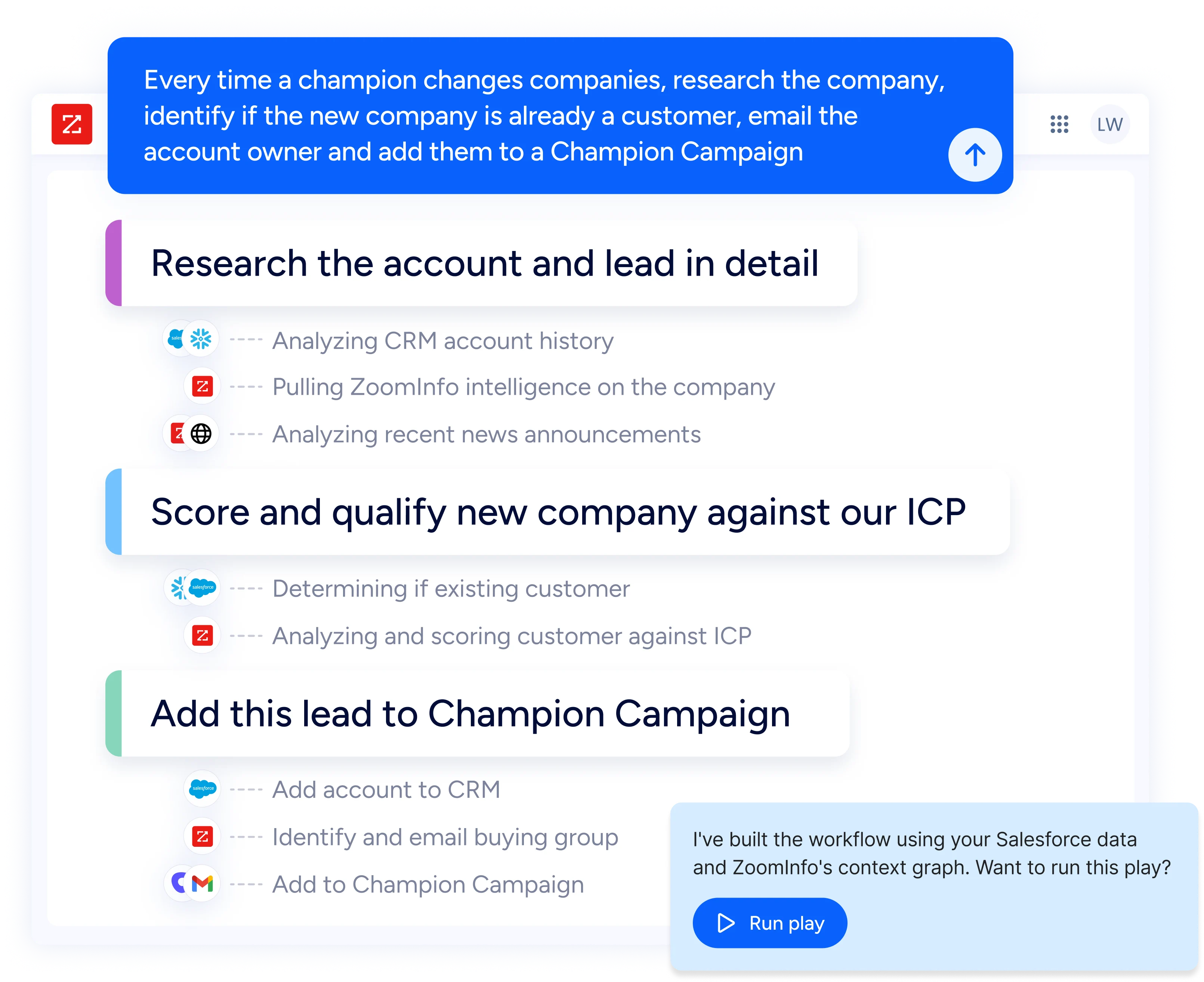
For ZoomInfo, the GTM Context Graph unifies CRM records, Chorus conversation transcripts, intent signals, and signal data to explain why deals move. Apollo's AI helps individual reps work faster on tasks like email writing and call summaries, but doesn't connect signals across the full deal lifecycle.
Analyst-validated and enterprise-ready
ZoomInfo is more suitable for larger businesses, as a Gartner Magic Quadrant Leader (ABM) and Forrester Wave Leader (Intent Data). Apollo holds G2 badges but no Gartner or Forrester placement.
ZoomInfo vs. Apollo: Feature comparison
Let's see how ZoomInfo compares to Apollo side-by-side.
Features | ||
|---|---|---|
Best for | Enterprise and upper mid-market GTM teams needing verified data depth and contextual intelligence across sales, marketing, and RevOps | Startups, SMBs, and individual reps needing fast, affordable prospecting and outreach in one tool |
Advanced security, compliance certifications, SSO, SOC 2, ISO 27001, GDPR compliant, Trust Center | No privacy certifications; security limited to SOC 2, ISO 27001 compliance | |
Pricing | Flexible packages and the option to start using for free via and on consumption-based pricing at GTM.AI | Starts at $49 per use per month, but more meaningful features only included in more expensive packages |
Global coverage | North America, Europe, APAC with consistent quality across | 270M+ contacts and 70M+ companies |
Technographics | 15,000+ technologies tracked, comprehensive tech stack data | Limited technographic data, basic technology tracking |
Real-time proprietary signals | Third-party Bombora data, weekly updates | |
AI capabilities | ZoomInfo enables easy access to AI to connect via MCP, API, or CLI through its headless offering GTM.AI as well as platform-based AI like Copilot | Basic AI features for sales engagement, like email drafting and call summaries, MCP and API available |
Platform type | All-in-one AI GTM platform | Consolidated sales engagement platform (data + sequencing and a dialer) |
Apollo vs. ZoomInfo: data quality & coverage
Data is always the foundation when it comes to GTM. So it makes sense to compare Apollo's coverage and quality against ZoomInfo's first.
ZoomInfo's data
ZoomInfo's database spans over 500M contacts and 100M companies, built from two decades of proprietary data collection plus third-party sources to fill gaps. Verification runs across multiple layers; machine learning models scan 28M site domains daily, deliverability testing, and a 300+ person human research team. The result is 135M+ verified direct dials and 300M+ verified business emails.
Independent validation backs this up: a Fortune 500 competitive RFP analyzing 25 million contacts concluded no competitor came close, and ZoomInfo was named a Leader in Forrester's Wave for Intent Data Providers with the highest possible scores across eight criteria.
Apollo's data
Apollo reports 270M+ contacts and 70M companies, sourced through a crowdsourced contributor network (2M+ sources such as connected inboxes, CRMs, and CSV uploads), its own engagement-suite verification (bounces and replies), public data crawling, and third-party providers. Apollo claims 91% email accuracy through a 7-step process.
The crowdsourced model grows with Apollo's user base, but it also inherits that base's bias: coverage skews toward the startups and SMBs Apollo's own customers sell into, with likely weaker coverage in niche, regulated, or international markets.

How Apollo's compliance compares to ZoomInfo's
ZoomInfo's approach to compliance is more comprehensive and better suited to larger enterprises than Apollo's, with annual compliance and security certifications maintained.
ZoomInfo's compliance
ZoomInfo maintains a certification stack that is renewed annually: ISO 27001, ISO 27701, SOC 2 Type II, TRUSTe GDPR Practices Validation, and TRUSTe CCPA Practices Validation. ZoomInfo is a registered data broker in California and Vermont and maintains a dedicated Trust Center.

TRUSTe validations are independent audits confirming the compliance practices, not just self-certification.
Apollo's compliance
Apollo holds ISO 27001 and SOC 2 Type 2 certifications, plus GDPR, CCPA/CPRA, and EU-US Data Privacy Framework compliance, hosted on AWS with encryption in transit and at rest. It does not hold ISO 27701 or data-broker registration, the certifications ZoomInfo highlights for regulated-industry buyers.

ZoomInfo versus Apollo: API, MCP & integrations
Both ZoomInfo and Apollo have API and integration options, but ZoomInfo stands out as having wider capabilities.
ZoomInfo is an all-in-one AI GTM platform
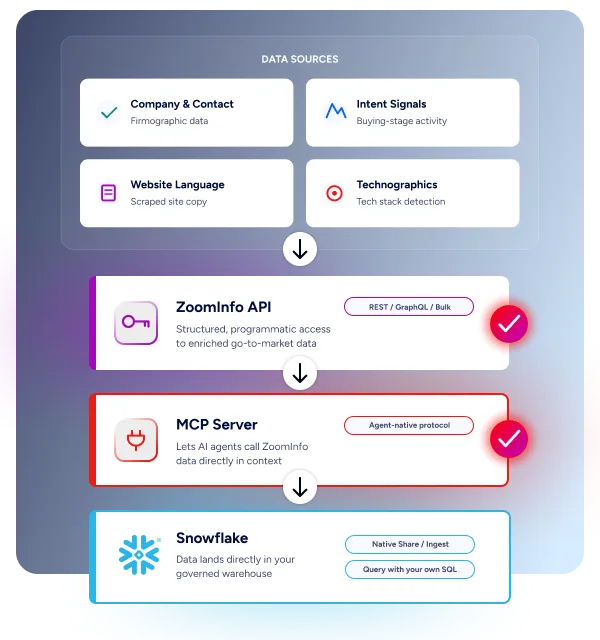
ZoomInfo is built on three layers, which means it's the go-to all-in-one AI GTM platform: Data, the GTM Context Graph, and universal access.
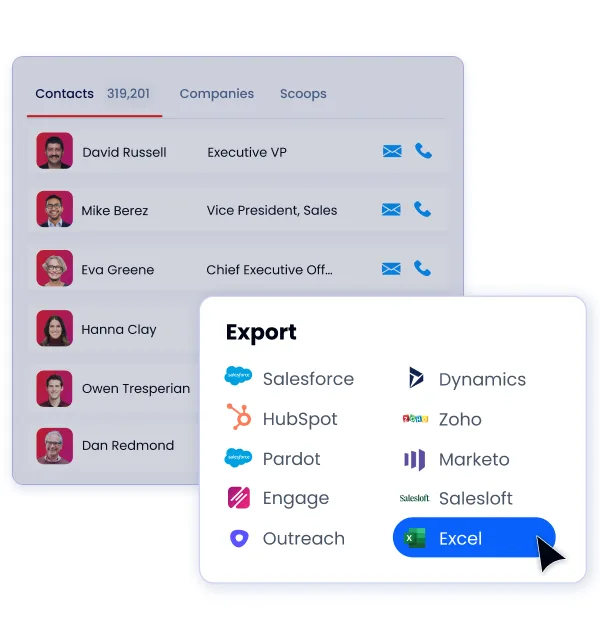
The way ZoomInfo is built means it can deliver data to you anywhere: headless through API, MCP, and CLI via GTM.AI, into your native systems through integrations (Salesforce, HubSpot, and more), or directly in the ZoomInfo UI. This flexibility fuels go-to-market teams across a variety of use cases.
Apollo's integrations, API & MCP
Apollo integrates natively with Salesforce, HubSpot, and Pipedrive, with additional connections to Outreach, Salesloft, Marketo, Sendgrid, and LinkedIn through its Integrations Marketplace.
Its REST API covers enrichment, search, and CRUD operations, but access requires a Custom (enterprise) plan, which blocks technical teams from evaluating programmatic capabilities before committing to a larger contract. Apollo also recently launched their MCP, which connects to Claude, ChatGPT and Perplexity so far.

ZoomInfo or Apollo: GTM execution
As we mentioned at the start, you can execute outbound and inbound motions with both ZoomInfo and Apollo. But who's best set up for fuelling a full GTM strategy?
Where ZoomInfo stands out
As a full AI GTM platform, ZoomInfo separates intelligence from execution: Buying signals sync directly into Salesloft Rhythm for AI-prioritized outreach, while GTM Workspace brings prioritized accounts, AI-drafted messaging, and deal execution into one native interface. Chorus, ZoomInfo's dedicated conversation intelligence product, is backed by 14 patents and feeds call context back into the GTM Context Graph, so insights from a single call inform account scoring, forecasting, and outreach for other reps, not just a call library.
Apollo = best for individuals
Apollo bundles the full outbound motion into one subscription: multichannel sequences (email, phone, LinkedIn, tasks), a built-in dialer, email deliverability tooling, AI personalization, and built-in call recording with AI summaries and coaching scorecards. Apollo claims reps can reach 100+ prospects per hour with auto-skip dialing.
This is Apollo's strongest pitch for individual contributors: prospect-to-sequence-to-call in one login, in minutes, at a fraction of the cost of stitching together point solutions.
ZoomInfo & Apollo.io’s pricing comparison
ZoomInfo offers a variety of pricing options, while Apollo has set subscription packages.
ZoomInfo's pricing
ZoomInfo offers flexible, scalable pricing tailored to your business goals, whichever area of the go-to-market team you're in. There's also the option to start using ZoomInfo for free, headless via GTM.AI, which runs on a consumption-based model for GTM Engineers and developers in the space.
Apollo's pricing
Apollo uses fully public, seat-based pricing: Free ($0, 900 credits/year), Basic ($49/seat/month annual), Professional ($79/seat/month annual), Organization ($119/seat/month annual, 3-seat minimum), and custom Enterprise. Credits are consumed per action: 1 credit per email, 8 per phone number, up to 9 per enriched record, and CRM/CSV enrichment requires Professional or above, with API access reserved for Custom plans.
Apollo's transparent entry-level pricing is genuinely attractive for small teams testing before they buy. It becomes a constraint once a team needs API access, deeper enrichment, or ABM capabilities that only unlock at higher (or custom) tiers.

Why teams are switching to ZoomInfo?
Teams switch to ZoomInfo when they need more than enrichment. With stronger data, better workflows, and real results, it’s the clear choice for revenue teams ready to scale.
Zoominfo is the GOAT contacts and email platform... the ability to get the right info I need to hunt
Mike Garcia
Sales Professional, Array Corporation (switched from Apollo.io)
I've used ZoomInfo at my previous 4-5 companies and as a result, I've become a champion of the tool. I was brought on at my current company to build an outbound motion and have replaced Apollo with ZoomInfo to successfully do that... better data quality and more robust tool
Jeff Kirchick
Sales Professional, allwhere (switched from Apollo.io)
I have tested Dun & Bradstreet, Apollo.IO, and Lusha. Zoominfo has way more richer tools, in my opinion, more accurate data, and more contacts
Oles Skakalskiy
Sales Professional, AssuredPartners
At Elite Printing and Packaging, we have used other software but have had the best experience with ZoomInfo Sales & Engage... More Quality emails, Phone #'s just better quality of leads, closing more deals
Debi Dessieux
Sales Professional, Elite Printing and Packaging (switched from Apollo.io)
Join the AI go-to-market platform powering 35,000+ companies


FAQs
What's the main difference between ZoomInfo and Apollo?
ZoomInfo is a full AI GTM platform; Apollo, on the other hand, is better suited to individuals and smaller teams looking for an outbound tool that needs data and outreach in one place.
Is Apollo an alternative to ZoomInfo
Apollo can serve as a budget alternative for basic sales engagement needs, but it's not a comprehensive substitute for organizations requiring high-quality data, advanced insights, and enterprise capabilities. Customer testing shows ZoomInfo delivering 20% better performance despite higher cost.
How does ZoomInfo ensure data accuracy?
ZoomInfo verifies every record using evidence-based algorithms, real-time updates, and proprietary Contact Accuracy Scores, resulting in 95%+ accuracy with <5% bounce rates. Apollo customers report up to 35% bounce rates and significant data quality issues.
Does ZoomInfo provide intent data?
Yes. ZoomInfo delivers proprietary, real-time intent signals like WebSights, Champion Tracking, Job Trends, and Scoops, unlike Apollo, which relies on third-party Bombora data updated weekly with limited signal types.
Can ZoomInfo identify who visits my website?
ZoomInfo offers superior data quality with 95%+ accuracy, comprehensive global coverage, and real-time verification. While Apollo claims large database numbers, customers consistently report data quality issues including up to 35% bounce rates, missing mobile numbers, and outdated information that impacts campaign performance.
Which platform offers better data coverage and quality?
ZoomInfo offers superior data quality with 95%+ accuracy, comprehensive global coverage, and real-time verification. While Apollo claims large database numbers, customers consistently report data quality issues including up to 35% bounce rates, missing mobile numbers, and outdated information that impacts campaign performance.
What kind of automation does ZoomInfo offer?
Yes. ZoomInfo supports 40+ native integrations with enterprise-grade capabilities, while Apollo offers good basic integrations plus native CRM functionality. ZoomInfo's integrations are built for enterprise scale with advanced features.
Why do companies choose ZoomInfo over Apollo?
Organizations choose ZoomInfo for superior data quality, comprehensive platform capabilities, enterprise-grade features, and proven ROI. While Apollo serves budget-conscious teams well, ZoomInfo delivers the data accuracy, advanced insights, and platform sophistication needed for serious revenue growth.
Does ZoomInfo integrate with CRM and marketing tools?
Yes. ZoomInfo supports 40+ native integrations with enterprise-grade capabilities, while Apollo offers good basic integrations plus native CRM functionality. ZoomInfo’s integrations are built for enterprise scale with advanced features.