Why do GTM teams choose ZoomInfo over Demandbase?
Demandbase is centered on ABM orchestration: identifying accounts, activating audiences, and coordinating advertising campaigns. ZoomInfo is centered on data, signals, and execution across both marketing and sales.
A larger verified database
ZoomInfo brings together 500M contacts, 100M companies, and 135M+ verified phone numbers, verified by more than 300 human researchers. Demandbase reports 176M+ contacts, 104M+ companies, and 54M direct dials.
Native conversation intelligence
ZoomInfo includes Chorus for native call recording, transcription, and deal insight. Demandbase does not offer conversation intelligence as a native capability.
Broader access through APIs and MCP
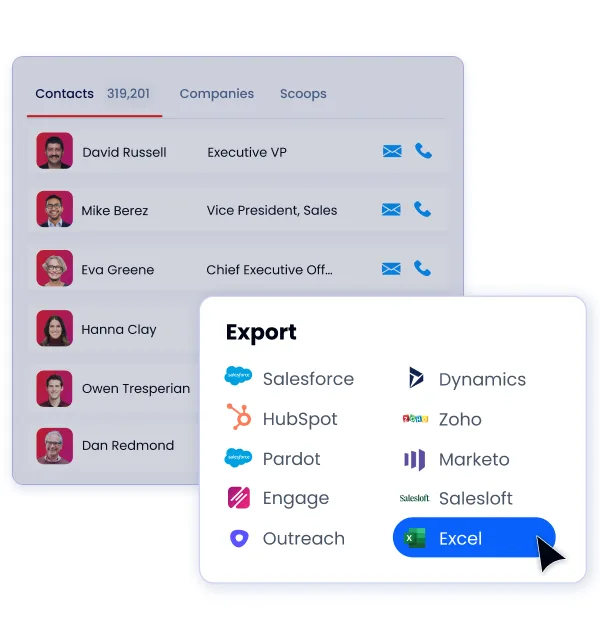
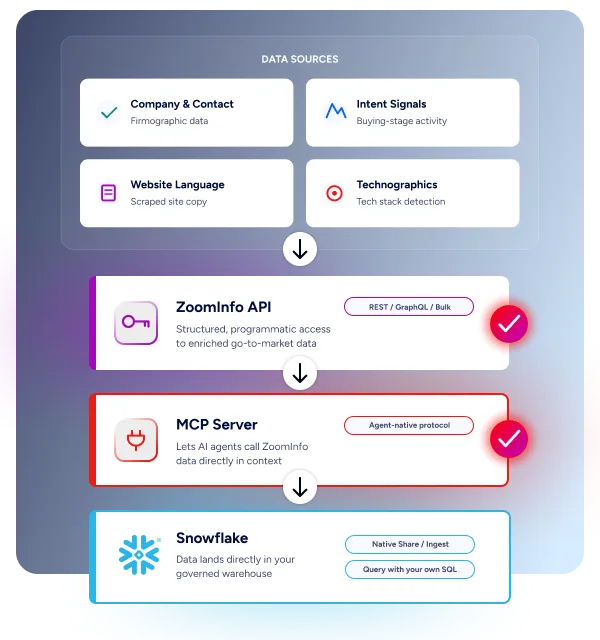
ZoomInfo can be used inside native workflows or accessed through APIs, MCP, and cloud data delivery to Snowflake and BigQuery. Demandbase supports REST APIs and an integration partner ecosystem, with no published MCP server equivalent.
ZoomInfo vs. Demandbase: Features comparison
Compare ZoomInfo directly to Demandbase from a high-level against core features.
Features | ||
|---|---|---|
Best for | Organizations running ABM/ABX across marketing and sales with shared data, signals, and execution | Marketing-led ABM programs centered on advertising |
Data scale | 176M+ contacts, 104M+ companies | |
Intent data | ZoomInfo Intent: 210M IP-to-org pairings and 6T+ keyword-to-device pairings/month | 2T+ signals/month, 810K+ keywords, 133 languages |
Intelligence layer | GTM Context Graph: 1.5B+ data points daily, fusing B2B data, CRM, Chorus, and behavioral signals | Demandbase Account Intelligence (account-level scoring) |
Conversation intelligence | No native capability | |
AI capabilities | GTM Workspace (seller execution) and GTM Studio (marketing orchestration) | Agentbase |
APIs and AI access | REST APIs | |
Pricing | Flexible packages and the option to start using for free via consumption-based pricing at GTM.AI | No published prices |
How the intelligence layers compare: Demandbase vs. ZoomInfo
One of the most important differences between the two platforms is how each builds and uses its intelligence layer.
ZoomInfo's GTM Context Graph
ZoomInfo's GTM Context Graph processes more than 1.5 billion data points per day, fusing ZoomInfo's verified B2B data with customer CRM history, Chorus conversation intelligence, intent signals, and behavioral data into a unified reasoning layer. That fusion means the account prioritization a rep sees in GTM Workspace, and the audiences a marketer builds in GTM Studio, draw from all of those signal types simultaneously, and the same intelligence is accessible via the ZoomInfo API or MCP server.
Demandbase's Account Intelligence
Demandbase Account Intelligence scores and prioritizes accounts using intent signals, firmographic attributes, and first-party engagement data within the Demandbase platform. That scoring feeds advertising and marketing workflows well, but the inputs are primarily digital signals captured through Demandbase's own ecosystem, with no conversation intelligence feeding the model and no published MCP-based access to deploy intelligence outside the platform.

Which platform has better B2B data: Demandbase vs. ZoomInfo
On raw contact scale, ZoomInfo has the clear advantage.
ZoomInfo's data
ZoomInfo reports 500M contacts, 100M companies, 135M+ verified phone numbers, and 200M+ verified business emails. ZoomInfo's multi-source verification process involves more than 300 human researchers cross-checking records and achieving up to 95% accuracy on first-party data, the verification rigor that makes large-volume database queries reliably actionable.
Demandbase's data
Demandbase reports 176M+ contacts, 104M+ companies, 54M direct dials, and 109M validated emails. That scale supports Demandbase's advertising and account-identification workflows well, though it is a smaller foundation than ZoomInfo's for teams that also need prospecting reach and TAM coverage alongside ABM.

Which platform is better for ABM: Demandbase vs. ZoomInfo
If your definition of ABM is tightly tied to account-based advertising and web personalization, Demandbase remains a strong choice. If it includes account selection, buyer signals, cross-channel activation, and sales follow-through, ZoomInfo is often the broader option.
ZoomInfo for ABM
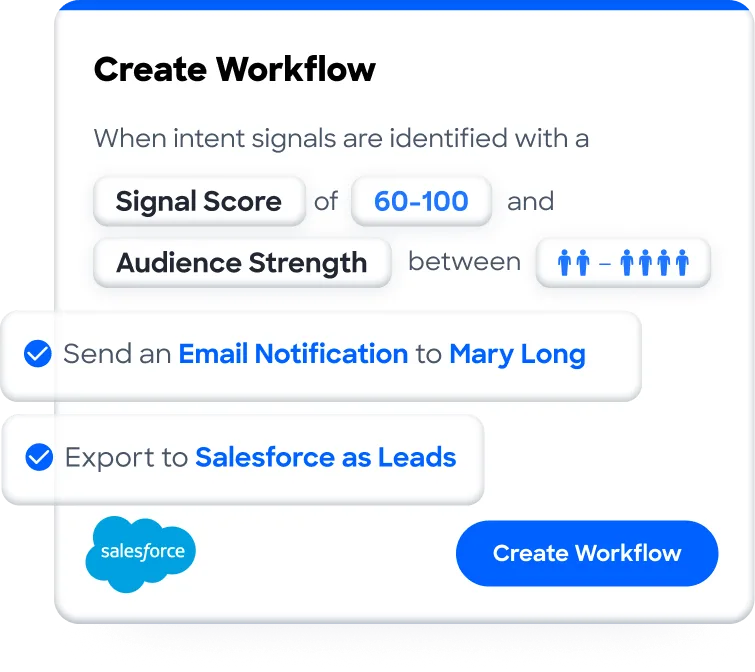
ZoomInfo Marketing builds audiences using intent data, buyer signals, and account fit scoring, enriches and expands buying groups with verified contact data, and activates audiences across channels including native DSP, web, email, and sales workflows. ZoomInfo Marketing is a Gartner ABM Platforms Leader for both 2024 and 2025, and Smartsheet reported a 40%+ increase in form fills and 84% increase in MQLs using these tools.
Demandbase for ABM
Demandbase's intent model is closely tied to its advertising engine and account identification workflows, reporting 2T+ signals per month across 810K+ keywords in 133 languages. That makes it particularly useful when media activation is central to the strategy, though execution beyond advertising typically depends on external tools.

Which platform is better for seller execution: Demandbase vs. ZoomInfo
This is one of the clearest differences in the comparison.
ZoomInfo's execution
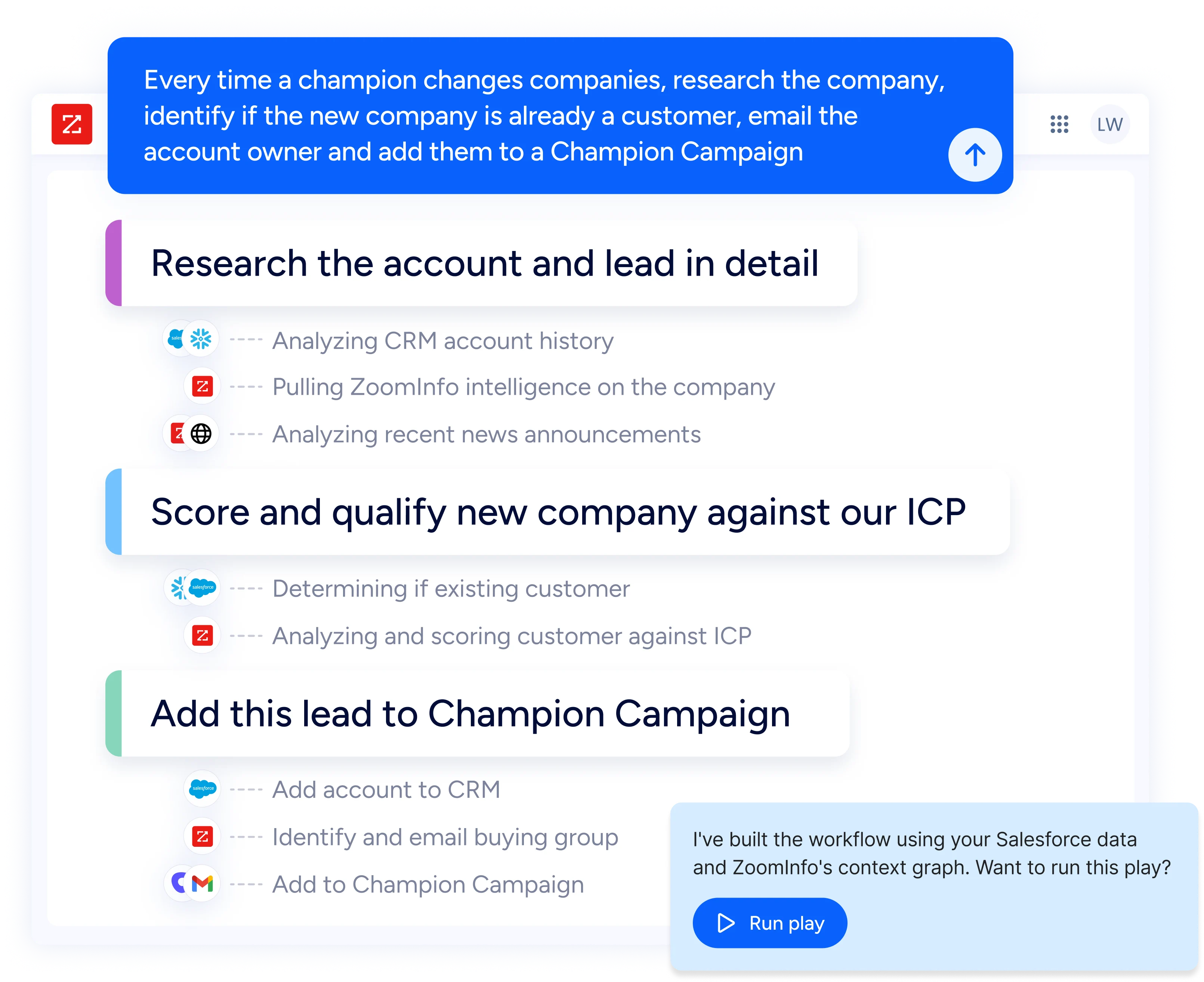
GTM Workspace gives reps prioritized accounts, AI-drafted outreach, and shared account context together in one place, generated from the same underlying data layer. Audiences, signals, and engagement insights from ZoomInfo Marketing are shared directly with sales via GTM Workspace, and Chorus adds native conversation intelligence for call review and deal analysis.
Demandbase's execution
Demandbase Sales Intelligence supports seller prioritization and account insight within the Demandbase One platform, surfacing hottest accounts and buying group members with pre-built plays. The actual outbound execution still depends on external tools for most sellers; Demandbase provides the intelligence, while the rep's workflow remains spread across other systems.
Demandbase vs. ZoomInfo: platform fit and implementation
Both platforms are credible options, and the right fit often comes down to onboarding speed and how tightly marketing and sales need to work together.
ZoomInfo's approach
ZoomInfo is usually the lighter starting point: teams can evaluate through ZoomInfo Lite or a free trial before expanding into broader workflows, backed by award-winning customer onboarding. Audiences and signals flow directly into GTM Workspace, connecting marketing and sales in unified workflows rather than requiring a separate handoff.
Demandbase's approach
Demandbase implies a larger implementation commitment, with a published services model that can stretch from initial setup into months of adoption and optimization, consistent with being a comprehensive enterprise ABM suite. Some users note a steeper learning curve for campaign setup and segmentation, and that account insights can require external tools to translate into sales follow-through.

Demandbase vs. ZoomInfo pricing
The two platforms take very different approaches to pricing transparency.
ZoomInfo's pricing
ZoomInfo offers flexible, scalable pricing tailored to your business goals, whichever area of the go-to-market team you're in. There's also the option to start using ZoomInfo for free, headless via GTM.AI, which runs on a consumption-based model for GTM Engineers and developers in the space. Teams can start with ZoomInfo Lite or a free trial before committing to a full implementation.
Demandbase's pricing
Demandbase does not publish pricing; the platform is fully quote-based with no free tier or self-serve entry point, consistent with its enterprise ABM sales process. Teams evaluating Demandbase should expect a sales conversation before seeing a number.

Why are teams switching to ZoomInfo?
Teams switch to ZoomInfo when they need more than enrichment. With stronger data, better workflows, and real results, it’s the clear choice for revenue teams ready to scale.
We can see everything in one place. We can see that the data is correct, understand the signals, and finally optimize our campaigns.
Shai Masot
Strategic Demand & Lead Generation
I’m really excited about the power of generative AI in general, and working with Copilot is a no-brainer because ZoomInfo is one of the key platforms in our tech stack.
Toby Carrington
Chief Business Officer
I give props to the data services team at ZoomInfo. They’ve done a really great job working with us to get us what we need.
David Gojo
Sales Data Science Manager
While our analysis initially suggested Cognism might have advantages for UK mobile data, we recognize ZoomInfo's broader capabilities and are willing to invest in the additional features like intent data. We've used ZoomInfo before and see the value in scaling our data volume with your platform
UK based Energy Company
Director of Sales
Join the #1 AI GTM platform powering 35,000+ companies


FAQs
Is ZoomInfo or Demandbase better for ABM?
Demandbase is often stronger for advertising-centric ABM. ZoomInfo is often stronger for ABM programs that need shared data, intent, audience activation, and close coordination with sales through ZoomInfo Marketing. ZoomInfo Marketing is a Gartner ABM Platforms Leader for both 2024 and 2025.
Does ZoomInfo offer native advertising?
Yes. ZoomInfo Marketing includes cross-channel advertising and audience activation capabilities, including a native B2B DSP.
Which platform has better contact data?
ZoomInfo has the larger verified contact database in this comparison, with 500M contacts and 135M+ verified phone numbers, verified by more than 300 human researchers. Demandbase reports 176M+ contacts and 54M direct dials.
Which is easier to implement?
ZoomInfo is typically easier to start with because teams can evaluate via ZoomInfo Lite or a free trial, then expand into broader workflows. Demandbase is fully quote-based with no free entry point.
Does Demandbase include sales execution tools?
Demandbase supports sales intelligence and account prioritization, but ZoomInfo is stronger in native seller execution through GTM Workspace and native conversation intelligence through Chorus.
What is the difference between Demandbase Account Intelligence and ZoomInfo's GTM Context Graph?
Demandbase Account Intelligence scores and prioritizes accounts using intent and firmographic signals within the Demandbase platform. ZoomInfo's GTM Context Graph processes more than 1.5 billion data points per day, fusing verified B2B data, CRM context, Chorus conversation intelligence, and behavioral signals into a unified reasoning layer, accessible via GTM Workspace, GTM Studio, and APIs plus MCP.