


ZoomInfo vs. LinkedIn Sales Navigator

ZoomInfo vs. LinkedIn Sales Navigator: What's the difference?

LinkedIn Sales Navigator is a social selling tool built on LinkedIn's professional network, designed primarily for relationship-based prospecting within that platform. ZoomInfo is an all-in-one AI GTM Platform that gives revenue teams verified contact data, cross-web intent signals, multi-channel execution, and open API access.

By submitting this form, you agree to ZoomInfo's Privacy Policy and Terms of Use.
You may unsubscribe at any time.

adobe
Microsoft logo1
Google logo1
airbnb logo.svg
Seismic Logo
Canva logo1
Snowflake
Figma logo.svg
adobe
Microsoft logo1
Google logo1
airbnb logo.svg
Seismic Logo
Canva logo1
Snowflake
Figma logo.svg
adobe
Microsoft logo1
Google logo1
airbnb logo.svg
Seismic Logo
Canva logo1
Snowflake
Figma logo.svg

Why do GTM teams choose ZoomInfo over LinkedIn Sales Navigator?

Sales Navigator gives you the LinkedIn profile and a path to connect through shared connections. ZoomInfo gives you the direct contact information plus the actionable context you need to reach out at the right time.

Better-Data-Globally

Verified contact data, not just profiles

ZoomInfo delivers 500M contacts, 120M direct-dial phone numbers, and 200M+ verified business emails alongside every contact record. Sales Navigator surfaces LinkedIn profiles with titles and company names, but no direct phone numbers or verified business email addresses at any tier.

All-in-One-Platform

Open-web intent, not just LinkedIn activity

ZoomInfo Intent monitors 210 million IP-to-organization pairings across the open web, tracking 4,500+ intent topics. Sales Navigator's intent is scoped to LinkedIn-native behavior: profile views, InMail responses, and ad engagement.

Real-Time-Signals-Automation

CRM integration without the seat minimum

ZoomInfo provides 120+ CRM and tech stack integrations across tiers. Sales Navigator gates full CRM sync to the Advanced Plus plan, which requires a minimum of 10 seats.

ZoomInfo vs. LinkedIn Sales Navigator: Features comparison

Compare ZoomInfo directly to LinkedIn Sales Navigator from a high-level against core features.

Features
ZI-logolinkedin-desktop

Core focus

All-in-one AI GTM Platform

Social selling on LinkedIn's professional network

Contact scale

500M contacts, 100M+ companies

1.3B+ LinkedIn members (no contact detail delivery)

Direct-dial phone numbers

120M direct-dial, 135M+ verified phone numbers

Not provided

Verified business emails

200M+ verified business emails

Not provided

Intent data

210M IP-to-organization pairings, 4,500+ topics, open web

LinkedIn-native signals (profile views, InMail responses, ad engagement)

CRM integration

120+ integrations across tiers

Advanced Plus only (10+ seats, enterprise)

Conversation intelligence

Not available

Starting price

Flexible packages and the option to start using for free via consumption-based pricing at GTM.AI

~$119.99/seat/month (Core, billed annually)

Which has better contact data: LinkedIn Sales Navigator or ZoomInfo?

Contact data quality depends on what "quality" means for your workflow: accuracy of identity, or completeness of contact details.

ZoomInfo's contact data

ZoomInfo covers both identity and reachability. The dataset includes not just who people are, but how to reach them (direct dials and verified emails), what technology their company uses (30,000+ technologies across 200+ categories), and what signals suggest they are in-market. Northwestern Mutual discovered contacts 75% faster with ZoomInfo, enabling reps to spend their time making direct dials rather than searching for phone numbers.

LinkedIn Sales Navigator's contact data

Sales Navigator performs well on identity accuracy: member-maintained profiles tend to reflect career changes quickly. The important caveat is that this model produces no verified contact details beyond what members choose to make public. There are no direct phone numbers, no business email addresses, no technology stacks, and no company financials. LinkedIn Sales Navigator holds a G2 rating of 4.3/5 from 1,854 reviews.

Mobile map global presence

Which is better for intent data: LinkedIn Sales Navigator or ZoomInfo?

Both platforms offer buyer intent data, but the signals come from different sources and measure different behaviors.

ZoomInfo's intent data

ZoomInfo Intent monitors 210 million IP-to-organization pairings across the open web, tracking 4,500+ intent topics spanning research on third-party review sites, competitor websites, technology evaluation pages, and industry publications. An account actively comparing your category on multiple surfaces registers as high-intent before they ever engage with your LinkedIn content.

LinkedIn Sales Navigator's intent data

Sales Navigator intent captures LinkedIn-native signals: profile views on saved accounts, InMail response patterns, ad engagement with your company's LinkedIn content, and real-time job change and activity alerts (Sales Spotlights). These signals are highly reliable within the LinkedIn ecosystem, but the limitation is scope: research happening on G2, a competitor's pricing page, or at a virtual event outside LinkedIn goes unseen.

Intent-Data-1-1

Which has better CRM and workflow integrations?

CRM integration is where the tier-gating gap in Sales Navigator becomes most visible for RevOps and sales operations teams.

ZoomInfo's integrations

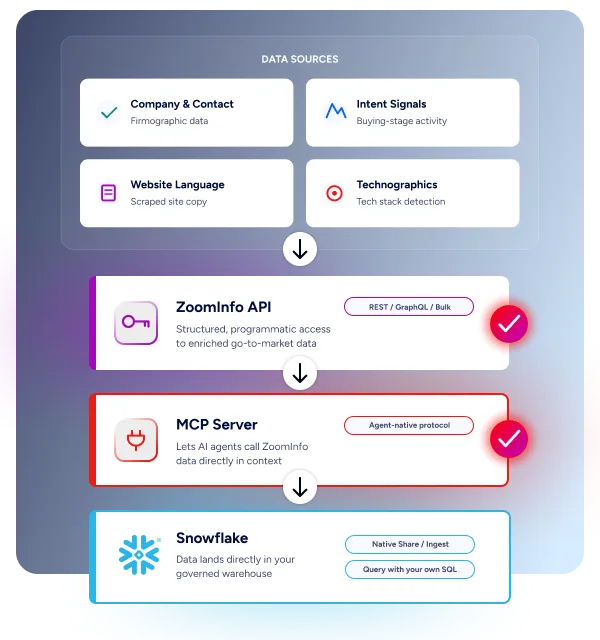
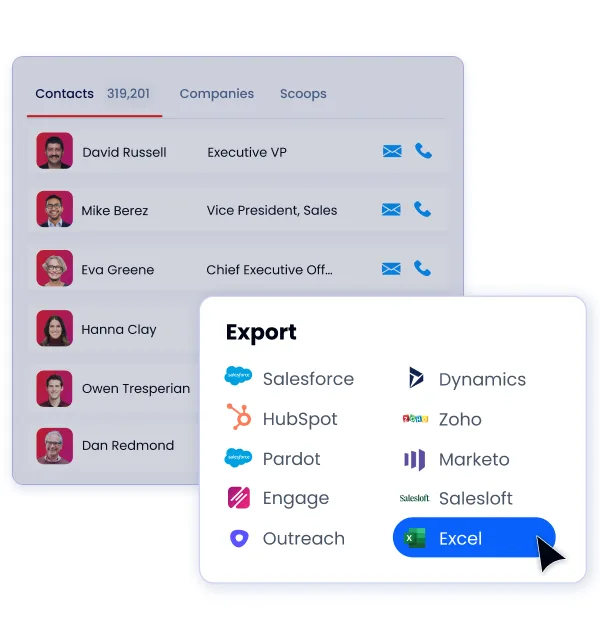
ZoomInfo provides 120+ CRM and tech stack integrations across tiers, including Salesforce, HubSpot, Microsoft Dynamics, Marketo, Outreach, and Salesloft. The Enterprise API and ZoomInfo MCP extend that access to any tool, workflow, or AI agent platform. Ryder System found it nearly 35% cheaper to invest in ZoomInfo's platform rather than pay for multiple piecemeal solutions.

LinkedIn Sales Navigator's integrations

Sales Navigator CRM integration is available on Advanced and Advanced Plus tiers. The Advanced Plus plan (10+ seat minimum, enterprise-quoted) provides the deepest integration: two-way CRM sync with Salesforce and Microsoft Dynamics, Sales Preferences pulled from CRM data, and activity writeback. The limitation is access: the vast majority of smaller or mixed-CRM teams cannot unlock this functionality without committing to the 10-seat requirement.

enterprise-integrations

LinkedIn Sales Navigator vs. ZoomInfo: platform breadth and the GTM Context Graph

Sales Navigator is purpose-built for one job: giving sellers access to the LinkedIn graph with prospecting tooling and InMail. ZoomInfo is built around a different architecture.

ZoomInfo's platform breadth

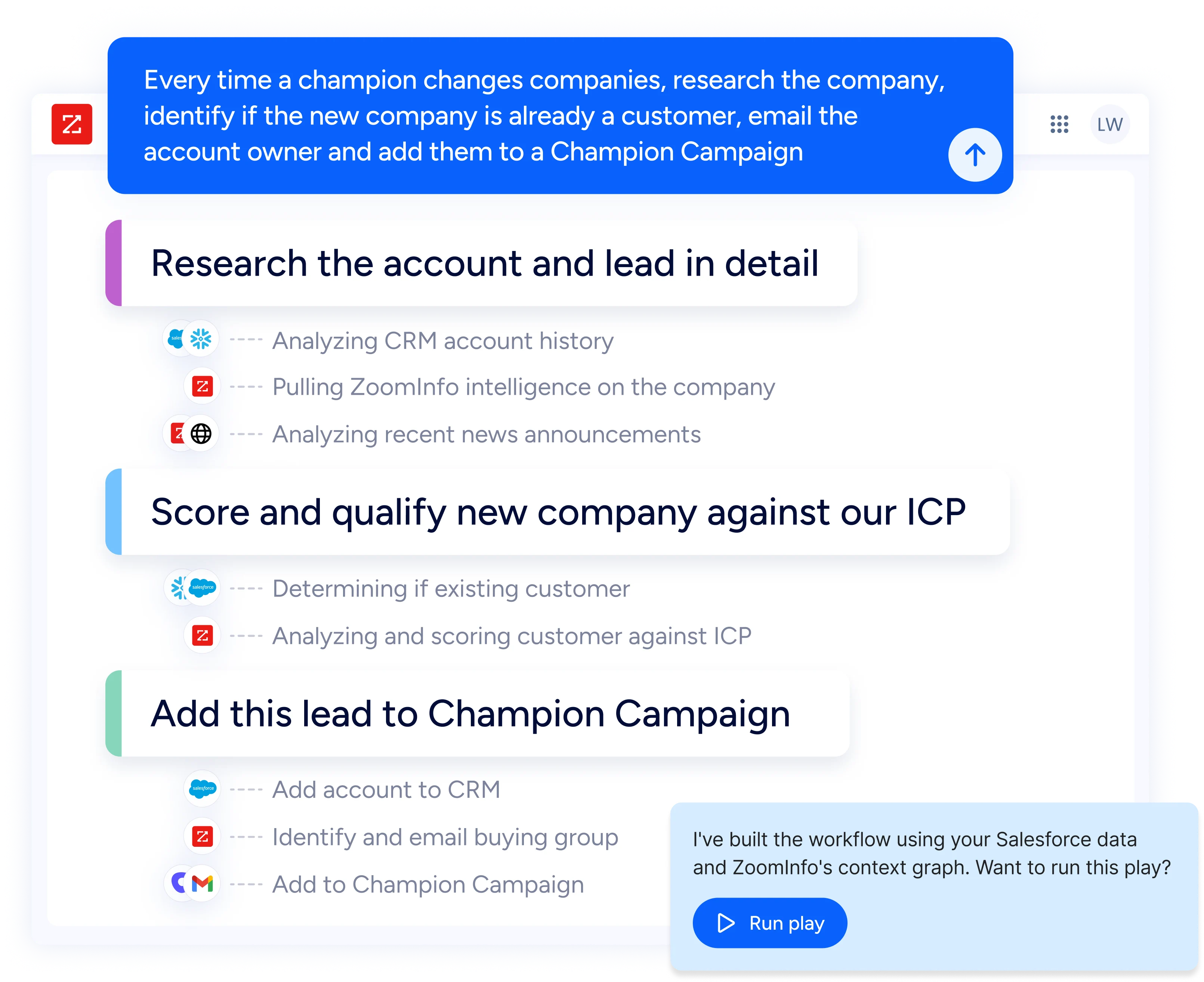
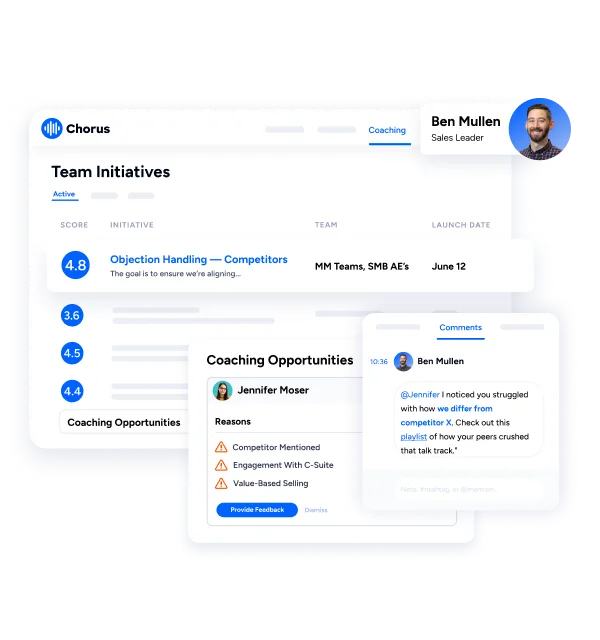
The GTM Context Graph sits at the center: a semantic graph that fuses ZoomInfo's verified B2B data with customer CRM records, conversation intelligence from Chorus, and open-web behavioral signals into a single, queryable intelligence layer. Built on that foundation, ZoomInfo delivers three access lanes: GTM Workspace for sellers, GTM Studio for marketers and RevOps, and APIs & MCP for developers and AI agent workflows.

LinkedIn Sales Navigator's focus

That LinkedIn-only focus is a genuine strength for teams whose primary motion is LinkedIn-native relationship selling. The flip side is that it does not expand beyond the LinkedIn surface: no cross-web data, no conversation intelligence, and no equivalent to a unified reasoning layer that spans CRM, calls, and behavioral signals.

New Workspace hero img

LinkedIn Sales Navigator vs. ZoomInfo pricing

The comparison most relevant for buyers is what's included at each price point, not just the sticker price.

ZoomInfo's pricing

ZoomInfo offers flexible, scalable pricing tailored to your business goals, whichever area of the go-to-market team you're in. There's also the option to start using ZoomInfo for free, headless via GTM.AI, which runs on a consumption-based model for GTM Engineers and developers in the space. ZoomInfo Lite is always free and gives teams access to verified contact data at no cost.

LinkedIn Sales Navigator's pricing

Sales Navigator Core runs approximately $119.99 per seat per month billed annually, and Advanced is approximately $179.99 per seat per month. Advanced Plus is enterprise-quoted with a 10+ seat minimum, and LinkedIn does not publish its dollar amount. The three tiers gate features progressively, and CRM sync specifically requires Advanced Plus, which is the most common stumbling block for mid-market teams.

CCS-track-key-contacts-3

Why are teams switching to ZoomInfo?

Teams switch to ZoomInfo when they need more than enrichment. With stronger data, better workflows, and real results, it’s the clear choice for revenue teams ready to scale.

We can see everything in one place. We can see that the data is correct, understand the signals, and finally optimize our campaigns.

Shai Masot

Strategic Demand & Lead Generation

I’m really excited about the power of generative AI in general, and working with Copilot is a no-brainer because ZoomInfo is one of the key platforms in our tech stack.

Toby Carrington

Chief Business Officer

I give props to the data services team at ZoomInfo. They’ve done a really great job working with us to get us what we need.

David Gojo

Sales Data Science Manager

While our analysis initially suggested Cognism might have advantages for UK mobile data, we recognize ZoomInfo's broader capabilities and are willing to invest in the additional features like intent data. We've used ZoomInfo before and see the value in scaling our data volume with your platform

UK based Energy Company

Director of Sales

Join the #1 AI GTM platform powering 35,000+ companies

Award imageAward imageAward imageAward image

FAQs

Is LinkedIn Sales Navigator better than ZoomInfo?

Neither is universally better. They serve different use cases and are frequently deployed together. Sales Navigator excels at LinkedIn-native prospecting, warm intro access through TeamLink, real-time Sales Spotlights, and InMail. ZoomInfo delivers verified direct dials, business emails, open-web intent signals, and multi-channel outreach that Sales Navigator does not provide at any tier. Many GTM teams run both, and the decision comes down to whether you need the LinkedIn graph layer alone or a full data plus execution platform.

Can ZoomInfo replace LinkedIn Sales Navigator?

ZoomInfo can replace Sales Navigator's prospecting and data functions with more comprehensive verified contact data, intent signals, and CRM integration. However, ZoomInfo does not replicate InMail, TeamLink warm intros, or native LinkedIn engagement signals. For outbound-focused teams running email and phone sequences, ZoomInfo's verified contact data typically delivers better results. For teams where LinkedIn outreach is the primary channel, Sales Navigator remains the right tool for that specific motion.

Does LinkedIn Sales Navigator provide email addresses?

No. LinkedIn Sales Navigator does not provide verified business email addresses or direct phone numbers at any tier. Members may share contact information voluntarily on their profile, but that is not part of the core product. ZoomInfo provides 200M+ verified business emails and 120M direct-dial phone numbers alongside every contact record, verified at 95%+ accuracy through continuous multi-source verification.

How much does LinkedIn Sales Navigator cost compared to ZoomInfo?

LinkedIn Sales Navigator Core is approximately $119.99 per seat per month billed annually. Advanced is approximately $179.99 per seat per month. Advanced Plus is enterprise-quoted and requires a minimum of 10 seats. ZoomInfo offers flexible, scalable pricing with the option to start for free, headless via GTM.AI, on a consumption-based model. ZoomInfo Lite is always free, and full enterprise platform access is custom-quoted based on team size, use cases, and consumption.

Do ZoomInfo customers also use LinkedIn Sales Navigator?

Yes. Many ZoomInfo customers run Sales Navigator alongside ZoomInfo. The combination is genuinely complementary: Sales Navigator provides the LinkedIn graph layer, InMail access, and Sales Spotlights; ZoomInfo provides the verified contact data, multi-source open-web intent signals, and multi-channel execution that LinkedIn does not include. It is not a forced either/or decision.